

Our pick of the five is the Dreo 1,500-watt radiator for its digital thermostat, 24-hour timer and remote. The Amazon Basics is the simple low-price choice and the Costway the no-frills pick. Size by 10 watts per square foot: a 1,500-watt model suits about 150 sq. ft.



How do you know which the best oil-filled heater is?
It’s a common question many ask and there is a lot to consider before you buy. In this article, I give you the most important things to consider before you buy, along with my picks for the best oil-filled heater.
Whether you have little to zero knowledge and would like to know more, or you just want a quick recommendation, this guide will help.
Let’s get into it!
About Oil-Filled Radiator Heaters

What exactly are oil-filled heaters?
Oil-filled heaters are an appliance that has metal columns and fins that contain oil inside which is subsequently heated to emit heat into a room. They are electric-powered are an efficient and convenient way to heat rooms and are a popular choice for many looking for a good oil space heater.
They use convection heating and are powered by electricity and are a great choice as a room heater. Many are also portable oil heaters which makes them great for use all around the house. You can also get oil wall heaters which you can mount to your wall.
How do oil-filled heaters work?
It is important to know how oil heaters work and produce heat before buying as the METHOD of heating may determine whether it is the right heater for you. An electric element heats sealed oil inside the metal columns. The oil holds that heat and passes it to the fins, which warm the air around them. The oil never gets used up, so it does not need refilling.
Oil Filled Heater efficiency
Are oil-filled radiator heaters efficient? The short answer is yes: like any electric heater, an oil-filled heater turns nearly all the electricity it uses into heat.
So how much can you expect to pay when using an oil-filled heater?
At the U.S. average residential price of 18.31 cents per kWh (July 2026, Energy Information Administration), a 1,500-watt heater at full power costs about 27 cents an hour, or about $4.39 for 16 hours. You can figure out how much you’ll spend using one 1,500-watt space heater, using this equation:
- Multiply 1500W by X hours of use = A.
- Multiply A by your electricity rate per kilowatt-hour = B.
- Divide B by 1000.
Convection heating vs. radiant heating Most heaters heat via 2 methods: convection or radiant. A radiant heater works by heating objects in a room directly. For example, the sun is a form of radiant heat. If you are directly under the sun you will heat up, as the sun heats up the surface of your body.
Radiant heaters do not directly heat air. Which brings us to convection heaters, which is what oil-filled heaters are.
Convection heaters heat the air directly by producing a warm surface which then heats up the air around it. Ultimately it means a convection heater heats the room, radiant heat heats objects in a room.
Are oil-filled heaters right for you?
There are a number of factors work considering when looking at buying an oil-filled heater. Below I will run through some things.
Oil-filled space heater safety
Oil-filled heaters are not without their risks and it is good to know what those risks are before you buy. We have created a detailed guide to oil heater safety which we think covers most of what you need to know.
The main concern with oil-filled heaters is that the units themselves create a warm surface. This can be dangerous for small humans and pets.
Features to look for when buying an oil heater for home comfort
- Thermal cutoff – a safety feature that will automatically turn your heater off if it gets too hot.
- Anti-freeze mode – some heaters switch themselves on when the room gets close to freezing. It is a thermostat setting, not a liquid inside the heater.
- Tip-Over switch – Another important safety feature which will automatically turn off your heater should it somehow get knocked over. It lowers the risk of fire.
- Covered elements – a few oil heaters these days now contained covered elements which alleviates one of the biggest safety concerns with oil-filled radiator heaters. This feature is not common yet but hopefully catches on. Only a couple of brands currently seem to have adopted this feature.
- Timer – a convenience feature that every oil filled heater should have. It gives you the ability to set when your heater turns on. I always set mine to turn off at a certain time at night and a certain time in the morning and without this feature, the heater would be highly inconvenient.
- Remote control – another reasonably important convenience feature for a radiant oil heater is the remote control. If you are like me you don’t want to walk over the machine every time you want to change a setting. Particularly if you are nice and cosy in bed.
- Smart heater – everything is going smart these days, and it certainly has its benefits if the accompanying app is of high quality. Being able to set schedules, and control your heater away from home adds that extra layer of convenience. Although there is not a huge product pool to choose from in terms of wifi-enabled oil-filled heaters, there are some around.
- Adjustable thermostat – quite an important convenience and money-saving feature. This enables you to set and forget. Choose a comfortable temperature and let the heater do the work. It will automatically try and keep your room at that temperature and will turn on and off as needed in order to sustain the temperature.
How do you prefer to be kept warm?
Above I ran through the principles of convection and radiant heating. How do you know what kind of heater is preferable for you?
Here are some tips:
- Large spaces with high ceilings will take a bit longer to heat, as heat rises. Unless of course, you have a ceiling fan to help circulate the warm air.
- Despite the above point, they are still better at heating rooms than radiant heaters.
- They are quiet
- They take longer to heat up than radiant heaters
- Ultimately your whole room will be warm, not just you.
Do you have kids or pets?
Unless you have one of the oil-filled radiator models that have covered elements, then you will want to be extremely careful if you have kids or pets. The surface elements of oil-filled heaters get hot and your small loved ones could very well get burnt. Be sure to ensure the safety of your small ones.
How big of an area do you need to heat?
A small room or a large room? Oil-filled heaters are fantastic for smaller rooms.
What’s the best oil heater for a large room?
Well, for the most part, oil-filled heaters are around 1500w or less, so if you are looking for a large oil-filled radiator heater, they are a little harder to find. You might find smaller or larger but on average, this is often the case. For other heater types, see our picks for the best space heater for a large room.
How much space does that heat?
A common rule of thumb is:
You’ll need roughly 10 watts of heating power for every square foot of floor area in the room. This means that a 1,500-watt heater can be the primary heat source for an area measuring up to 150 square feet.
Always take into account the size of the room you are primarily going to be heating. Chances are, if it is larger than 150 sqft then you may need either 2 heaters or another method of heating your room (optimally). Alternatively, if you have a smaller room you could always opt for a small oil-filled heater.
Get matched with a local HVAC technician
Repairs, installs and tune-ups. Networx matches you with vetted pros near you. Free, no obligation.
Length of Warranty
The great thing about oil-filled heaters is that they generally last a long time. No planned obsolescence. We have had our one for a number of years and it is still going strong. With that said, pay attention to the length of the warranty. Different manufacturers offer different warranty periods. You want to be covered for as long as possible.
Oil-Filled Heater Reviews
While we have run through all the products in this list extensively to bring you all the pros and cons of each heater and tried to make this as accurate and helpful as we can, be sure to read reviews. Whether it might be the heaters in this article or others, reviews can give you little tidbits about the model you are looking at. They also will indicate if the unit has inherent problems to avoid when numerous reviews mention a product has the same issues.
How much Electricity do oil-filled heaters use?
The U.S. average residential electricity price was 18.31 cents per kWh in July 2026, according to the Energy Information Administration. For a 1500w heater, that means you will be paying around 27 cents per hour of usage at full power. Obviously, there are a number of variables involved in estimating what you might be paying a month. How often you use the heater, what settings, duration, and price of electricity all contribute one way or another to the cost, but that should give you an indication of how much electricity an oil-filled heater uses.
Why buy an oil-filled heater?
Still unsure whether an oil heater is for you? Here are some of the benefits of an oil-filled radiator heater:
- They are silent
- Produce long-lasting heat
- Turn nearly all their electricity into heat
- Better at heating whole rooms
- No fan to blow dust around
- Your room will stay warm after it is turned off
- Low maintenance
- Durable
- Save money with eco modes and thermostats
- Portable
- Even spread heat
Pick the appliance or type its watts, set the hours and your state: the cost per hour, per night and per month, before you buy.
Our choice for the best oil-filled heaters
Dreo Oil-Filled Radiator Heater Review
DREO Oil Filled Radiator Heater, 1500W, Digital Thermostat, Remote, 24H Timer
This Dreo replaces the NewAir AH-450B we reviewed here, which Amazon no longer lists. It is the digital pick of the five: a touch panel with a large LED display, a remote control and a 24-hour timer, which is what the NewAir offered too, with finer control.
And it is a sealed oil heater, so there is nothing to refill. The seven wavy fins give it a large surface, and with no fan it is silent.
- Features Three power levels (600, 900 and 1,500 watts) and four modes including ECO, which holds the temperature you set and cycles the heater down once the room is there.
- Timer and remote The 24-hour timer lets you have it come on before you wake and go off after you leave. The remote handles power, mode and temperature from the bed.
- Safety Tip-over protection, overheat protection, a child lock on the panel, fire-resistant housing and an ETL listing. The top and fins still get hot, so keep it three feet from bedding and curtains.
- Size and moving it Large wheels and handles, so it rolls between rooms. As with any 1,500-watt heater, plan on about 150 square feet of real coverage; Dreo’s “large room” wording is a best case.
| ✅ Pros | ❌ Cons |
|---|---|
| Digital thermostat, remote and a 24-hour timer | Costs more than the basic radiators here |
| Silent, with no fan | Heavy to lift up stairs |
| Tip-over and overheat protection, child lock, ETL listed | Surface gets hot, like any oil radiator |
| Three power levels and ECO mode |
What’s to like
The 24-hour timer and the remote are what set it apart from the plain radiators below: you can have it warm the room before you wake and switch itself off after you leave, without getting up. ECO mode holds the temperature you set, the three power levels let you run it low in a small room, and the wheels and handles make it the easiest of the five to move.
What’s not to like
It costs more than the basic radiators here, and like every oil-filled heater it is heavy and slow to warm a big room. Treat Dreo’s “large room” wording as a best case: at 1,500 watts, plan on about 150 square feet of real coverage.
Amazon Basics Oil-Filled Radiator Heater
Amazon Basics Portable Oil-Filled Radiator Heater, 7 Fins, 3 Heat Settings, 1500W
This Amazon Basics radiator replaces the Mill oil heater we reviewed here, which Amazon no longer lists in the US. It is the plain, affordable pick: three heat settings, an adjustable thermostat, and nothing else to learn.
- Features Three heat settings, 600, 900 and 1,500 watts, and an adjustable thermostat that cycles the element to hold the room where you set it. Seven wavy oil-filled fins spread the heat, and the sealed oil never needs topping up.
- Heat that lingers Like every oil radiator, the fins keep giving off warmth for a while after the element switches off, which suits a bedroom where you do not want a fan running.
- Safety Tip-over and overheat protection, fully enclosed heating elements and an ETL safety certificate. Switch it off yourself rather than leaving it running unattended.
- Size Count on about 150 square feet of real coverage from 1,500 watts.
| ✅ Pros | ❌ Cons |
|---|---|
| Simple controls | The listing shows no timer or remote |
| Silent | Slower to warm a room than a fan heater |
| Tip-over and overheat protection, ETL certified | Heavy |
| Low price |
What is to like If you want the basics done properly at a low price, this is the one. If you want a timer, a remote and a display, the Dreo above is the better buy.
What’s not to like
The listing shows no remote or timer, so you set it by hand and switch it off yourself, and like every oil radiator it is heavy to carry.
Costway Radiator Heater
COSTWAY Oil Filled Radiator Heater, 1500W Portable Space Heater with Adjustable Thermostat
Simple, basic heat with no frills. That, in essence, sums up this little oil filled electric heater. It does not have bells and whistles and is not digital or have a digital display. That can work either way for people but many commented that it kept things very simple. One way it can help to be analogue, is that when there is a power surge, or the heater is turned off, it will turn back on to your original settings. In many digital appliances, if that happens, all your settings can be wiped and you will have to reprogram everything. Also, with the old school control panel, there really is very little room for confusion.
Heat settings
This unit has 3 heat settings of low, medium and high and it is a 1500 watt oil filled radiator heater. The 3 heat settings are 600, 900, or 1500 watts. This feature is great as it gives you the ability to control how much power you are using and also, how much the heater will use. An example of this feature in action would be if you use your heater in 2 different rooms. One might be considerably larger than the other, which would, therefore, require more heat. If you didn’t have these settings, you might move back to the smaller room, and get blasted with heat, using far more heat a power that is sufficient to heat your room.
Safety Features on the Costway Radiator heater
This oil filled heater has all the important safety features.
- Overheat protection
- Tip-over auto shut-off
- Along with that, the heater is UL listed, which means it has passed independent safety standards
Adjustable thermostat In my opinion, a thermostat is one of the most important features of an oil-filled heater. It means that a) you are able to set and forget and b) you can save money by not having the heater on constantly. Just turn the knob to a heat setting of your comfort and let the heater do the rest. You can obviously turn the knob up and down to adjust the temperature the thermostat will work too.
Portability Oil heaters are kind of heavy. Mine certainly is. Having a means to carry or move it is especially important if you plan to move the heater between rooms. I know my oil heater would be a nightmare to move without any wheels and a handle. Fortunately, this Costway oil filled heater also contains wheels and a handle for easy portability.
Will it burn the carpet? This is a question that gets asked a lot when it comes to oil-filled radiator heaters. The last thing anyone needs is charcoaled carpets! Well, to answer the question: the heater stands on its own feet or wheels, off the carpet, so it should not scorch it. The base and fins do get hot, so keep rugs, cords and fabric clear and follow the manual.
| ✅ Pros | ❌ Cons |
|---|---|
| Analog for simple use & Tip-over shut off switch | Has been known to emit a smell |
| Ul listed & Overheat protection | The cord is at the front of the heater which makes it a little awkward |
| 3 heating settings & Adjustable thermostat | No remote control |
| Wheels and handle for easy manoeuvrability | No timer |
| Solid quality &Inbuilt cord storage & Free maintanance |
What is to like and what’s not
As we mentioned at the start this is a no-frills oil radiant heater. It does what it is meant to do with little fuss. You can be comforted by the fact it has numerous, fundamentally important safety features, such as tip-over auto-shutoff switch and overheat protection and is safety certified. It does have a thermostat but it would have been nice if this model had a timer also. One thing I would miss on my oil heater is the ability to set the heater to turn on/off. Unfortunately, this model does not have that ability. Overall, a good solid, basic oil heater that does the job well. Have a look for yourself. Find out why it’s one of the best oil space heaters at Amazon.com
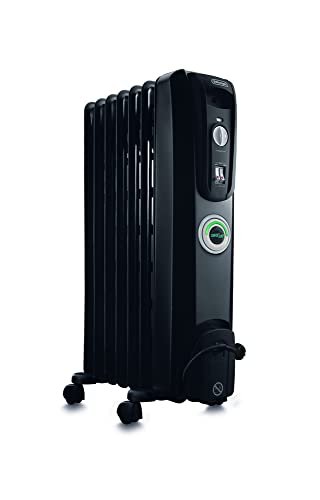
DeLonghi Heater Comfort Temp
De'Longhi Comfort Temp Full Room Radiant Heater, Black
The DeLonghi comfort temp is another oil heater that aims to focus on the fewer frills approach. There are not really too many things about the heater that makes it stand out from others in terms of features, but it does do the job it is meant to do well.
Having said that, there is one feature that it promotes that is a little different to other oil heaters and that is its “comfort temp technology” We will detail what this feature is below. But let’s kick off the with the heat settings.
Heat settings Much like the Costway heater this DeLonghi heater is an analogue heater. No digital parts, just old school knobs and levers to control functions. This could be good for some and maybe not for others. In this case, it is good as there is little fuss and basically zero learning curve on how to use the heater. There are 6 heat settings from a low setting to high. BUT.
The problem is, there is no mentioned temperature or any way to gauge what temperature each setting is This means it will take a little trial and error to figure this out. Not quite a plug and play heater, but after a number of days/nights with the heater on you will quickly figure out which setting is going to be right for you.
Or alternatively, you can use the “comfort temp technology” feature which negates the use for setting your own temperature. More on that to come.
Safety Features
Safety is always important and is something that has been considered with this heater. You can rest easy knowing this heater has been ETL listed, so has undergone independent safety testing. One of the important safety features this heater has is the thermal shutoff, which turns the heater off it becomes too hot.
Portability
Moving oil-filled heaters can be a pain in the bum. My one certainly is. If it is hot, it becomes extremely difficult to move, as it has one handle on the front, but nothing on the back to support it. So I would have to be holding a hot element. I guess they expect me to move the heater before I use it.
It is not ideal, but luckily I’m not one to move the heater around a lot. How about the DeLonghi? It kind of has the same issue. It only has a handle and a small slot on the front of the heat which leaves you with the same problem I have with mine.
Nowhere to put your other hands to pick the heater up or support it. If you move your heater around when hot, this is not ideal. A number of users have commented on this.
Features The adjustable thermostat on this DeLonghi Oil heater works automatically. However, for an analogue heater, the buttons and knobs actually are quite confusing. A number of users have commented on the overly complicated nature of these.
Also, as mentioned above this issue is there is no number put on that temperature. And that brings us to the stand out feature this unit has that most other oil-filled radiator heaters do not.
The “comfort temp technology”. What this feature is, is effectively a push-button thermostat. Push the button and it will automatically try to keep the room temperature to between 68 to 70F, which is considered a comfortable temperature.
There isn’t really anything special about what this feature does, but it can save you fooling around with knobs and settings and gives you a fast easy way to get comfortable and a reason not to play around with the confusing temperature settings.
Antifreeze function One thing you want to avoid with oil-filled heaters is to have their pipes freeze. I enjoy the irony of a frozen heater, but you will not if you are unfortunate enough to have this happen. Effectively, this can ruin your oil filled heater. The DeLonghi has taken steps to ensure this doesn’t happen with an ‘antifreeze’ feature, which will turn the heater on automatically when the temperature gets around 41F to ensure the pipes do not freeze.
| ✅ Pros | ❌ Cons |
| Quiet | Has leaked oil on a few occasion |
| Heats well | Unit gets quite hot |
| Proven quality | Confusing heat switches |
| Antifreeze feature | Difficult to move |
What is to like and what’s not?
I like this heater because it is one of the more proven models available. It has the usual safety features you should expect from an oil-filled heater and is extremely simple to use, with no maintenance or learning curve. The antifreeze feature is great if you leave in those extremely cold areas.
The “comfort temp technology” in my opinion is mostly gimmicky, but you cannot really complain about a unit that works adequately with only the press of a button. It is quiet, and it heats the room well.
Some issues that I wasn’t fussed with was the fact this model has leaked oil more than a couple of occasions. Though the likelihood of this happening is likely very low that does give me some cause to concern.
Moving the heater is not the easiest and the settings are more complicated than they need to be. Have a look for yourself. Find out why it’s one of the best electric radiator heater options at Amazon.com
DeLonghi EW7707cm Oil Filled Space Heater
De Longhi Comfort Temp Full Room Radiant Thermostat
This DeLonghi EW7707 heater is basically an older version as the above Delonghi heater we have already reviewed but with one less crucial safety feature – a tip over switch. Again, it takes a less-is-more approach.
Heat settings The EW7707 utilizes a ‘variable heat’ dial which can be good or can be bad depending on your outlook. It can be good if you want 100% control over what temperature output you have, as you can adjust it in tiny, or large increments, depending on your needs. The negative to that variable heat is it may take some time to get used to it. As there is no set temperature on the dial, you will have to find where on the dial is optimal for you. So it there is likely to be some experimentation involved initially.
Safety Features So, this heater has a number of safety features including being ETL listed. This means this heater has been ETL listed, so has undergone independent safety testing. Another important safety features this heater has is the thermal shutoff, which turns the heater off it it becomes too hot.
One safety feature it does not have is a tip-over switch, which will turn the heater off if it tips over. Portability Moving oil-filled heaters can be a pain in the bum. My one certainly is. If it is hot, it becomes extremely difficult to move, as it has one handle on the front, but nothing on the back to support it. So I would have to be holding a hot element. I guess they expect me to move the heater before I use it. It is not ideal, but luckily I’m not one to move the heater around a lot. How about the DeLonghi? It kind of has the same issue. It only has a handle and a small slot on the front of the heat which leaves you with the same problem I have with mine. Nowhere to put your other hands to pick the heater up or support it. If you move your heater around when hot, this is not ideal. A number of users have commented on this.
Features A couple of features of this heater are a little different to some other oil heaters. The first being the ability to change between 700, 800 and 1500 watt usage. Other heaters may have high, low and eco modes which is similar, but they often don’t specify what wattage you are using.
While I think there is little point in having both 700 and 800 options, given the difference is so little, at least you do have options. The other feature, which the previously reviewed Delonghi has, is the’ comfort temp’ feature, which effectively a push-button thermostat.
Push the button and it will automatically try to keep the room temperature to between 68 to 70F, which is considered a comfortable temperature.
There isn’t really anything special about what this feature does, but it can save you fooling around with knobs and settings and gives you a fast easy way to get comfortable and a reason not to play around with the confusing temperature settings.
Antifreeze function
DeLonghi has taken steps to ensure the pipes in your heater don’t freeze with an ‘antifreeze’ feature, which will turn the heater on automatically when the temperature gets around 41F. This will prevent your oil heater from getting damaged in cold winters.
|
✅ Pros |
❌ Cons |
| Quiet | Bright light is not dimmable |
| Heats well | Fins get very hot |
| No tip over switch | |
| Antifreeze feature | |
| Maintenance free |
What is it like?
For the most part, this is a proven heater. It is solid in its heating abilities. The functionality is not too complicated, despite the silliness of the heat settings/wattage buttons. There is no assembly or maintenance required and it has a ‘1 press heat’ comfort temp feature. The antifreeze is a nice touch and the variable heat could be a good thing depending on your preference.
What’s not to like Probably the biggest safety issue is the absence of a tip-over switch. Many other oil heaters have this, and why wouldn’t you want it? The fins on this heater can also get very hot so you will want to be extra careful if you have small humans or pets around. Also, the comfort temp light can be an annoyance for some if the heater is used in a bedroom. Check it out! Find out why it’s one of the best-selling oil heaters for home comfort at Amazon.com
Oil-Filled Electric Heaters – Additional reading
Obviously, there are many oil-filled heater options to choose from. A popular option, which we didn’t include, was the Insignia htrfbk6 oil-filled radiator heater.
Why didn’t we include this heater? Well according to Insignia, this heater has been discontinued. It may still turn up on Amazon.com from third-party sellers, but we don’t recommend buying a discontinued heater.
Honeywell oil-filled radiator heater – is this any good?
I wanted to address this particular heater as Honeywell is a very popular brand, and a Honeywell heater is often sought out due to the companies reputation with heating and cooling products. Owner reviews of the Honeywell oil-filled heater are mixed.
For my liking, there have just been too many instances of the oil-filled heater breaking down or not working far earlier than it should. You can read about what others are saying about it here.
By now you probably have an idea of whether oil-filled heaters are for you and what the best oil filled space heater options are. As we have mentioned, each type of heater has its pros and cons. Be sure to check out our other useful guides related to oil-filled heaters:
Founder of Home Caprice. Benas started the site to simplify HVAC after dealing with the heating and cooling in his first apartment.


