

Our pick is the Dr. Infrared DR-968, a 1,500-watt quartz and PTC heater with tip-over and overheat shut-offs, a 50 to 85°F thermostat and a UL listing. Of our three picks, the DR-978 is the lighter option and the Heat Storm Phoenix Wi-Fi mounts on a wall. Every plug-in infrared heater tops out at 1,500 watts, about 150 square feet by the common sizing rule.
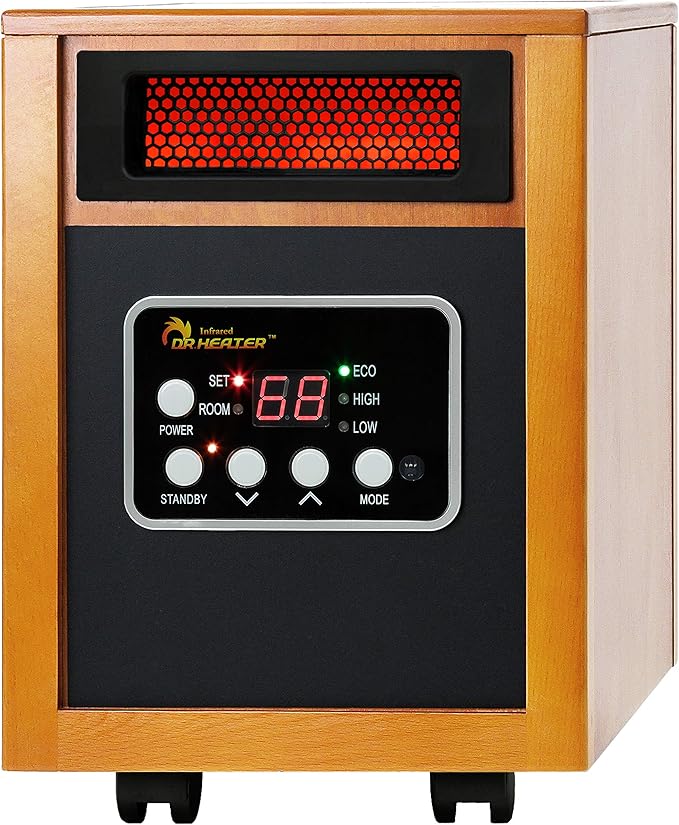


Our pick is the Dr. Infrared DR-968, a 1,500-watt heater that pairs a quartz infrared tube with a PTC ceramic element and has tip-over and overheat shut-offs, a 50 to 85°F thermostat and a UL listing. Every plug-in infrared heater tops out at 1,500 watts, which covers about 150 square feet by the common sizing rule. So choose on safety features, controls and cord length, not on the square footage printed on the box.
The best infrared heaters, by job
We took every figure below from the maker's own product page or manual, as of October 2026. Where a maker does not state something, we say so instead of filling the gap. Specs change between production runs, so check the listing and the label before you buy.
Best overall: Dr. Infrared DR-968
The DR-968 is the heater most people picture when they hear "infrared heater": a wood-look cabinet with a blower. Inside, Dr. Infrared combines an infrared quartz tube with a PTC (positive temperature coefficient) ceramic element. It runs at 1,000 or 1,500 watts, with an ECO mode that switches between the two to hold your set temperature.
It has the full set of safety features we look for. The Dr. Infrared DR-968 product page lists tip-over and overheat protection, a UL certification, an electronic thermostat from 50 to 85°F, a 12-hour auto shut-off timer, an IR remote and a 39 dB noise rating. The 2024 owner's manual adds a second cut-off that trips if the air intake gets blocked.
Dr. Infrared's current page gives no cord length; a retailer's DR-968 spec sheet lists 6 feet and a cUL/UL listing. Weight is 18 pounds in the 2024 manual and 20 on the product page, so treat it as roughly 20. Skip the "60% more heat output" line on the product page: no 1,500-watt heater puts out more heat than another, as the efficiency section below explains.
Lighter and smaller: Dr. Infrared DR-978
DR. INFRARED HEATER DR-978 Dual Heating Hybrid Portable Infrared Space Heater
We earn a commission if you buy through this link, at no extra cost to you.If you want the same quartz-plus-PTC design in a heater you can carry from room to room with one hand, the DR-978 weighs 10.4 pounds and measures about 12 by 9 by 9 inches, per its 2026 manual. That is roughly half the weight of the DR-968.
The controls and safety features match its bigger sibling. The DR-978 product page lists 1,000 and 1,500 watt settings plus ECO, a 50 to 85°F thermostat, a 12-hour timer, a remote, tip-over and overheat shut-off, and UL and cUL certification, with a 3-year parts and component warranty. Neither the page nor the manual gives a cord length or a coverage figure.
Get matched with a local HVAC technician
Repairs, installs and tune-ups. Networx matches you with vetted pros near you. Free, no obligation.
Best for a wall: Heat Storm Phoenix Wi-Fi HS-1500-PHX-WIFI
Heat Storm HS-1500-PHX-WIFI Infrared Heater, Wifi Wall Mounted
We earn a commission if you buy through this link, at no extra cost to you.The listing we link is the Wi-Fi model; its Phoenix Wi-Fi owner's manual (model HS-1500-PHXG-WI) is the source for the figures here. It is a flat heater, 19 by 4 by 16 inches, that screws to the wall, which suits a small bedroom or office with no spare floor. It uses a quartz infrared element with a fan and has two heat settings: full 1,500 watts and a low mode at half power. In auto mode it runs at full power until it is within 2 degrees of your setting, then drops to half power.
Heat Storm frames coverage the way the sizing rule does. The manual says it is designed for supplemental heating in spaces from 150 to 750 square feet, and the Phoenix product page puts the 150 figure as primary heat. The manual lists a thermostat limiter that cuts power if the inside overheats, a tip-over shut-off (error code El), a child lock, a remote, a run timer in hour steps (the Smart Life app adds on and off timers) and a 42 to 47 dB rating. It weighs 8.45 pounds.
Two things to check. The cord is only 3 feet long, so mount it near an outlet; the manual rules out extension cords and asks for a circuit of its own. And neither the manual nor the product page names a safety listing, so look for the UL, ETL or CSA mark on the unit's label. Our Heat Storm Phoenix Wi-Fi review covers the app.
Pick the appliance or type its watts, set the hours and your state: the cost per hour, per night and per month, before you buy.
Infrared heaters compared
| Heater | Power | Element | Maker's coverage | Safety listing | Cord | Tip-over / overheat | Thermostat and timer | Remote |
|---|---|---|---|---|---|---|---|---|
| Dr. Infrared DR-968 | 1,000 / 1,500 W, ECO | Quartz tube plus PTC, fan | Not stated | UL (cUL/UL per retailer) | 6 ft (retailer) | Yes / yes | 50 to 85°F; 1 to 12 h | Yes |
| Dr. Infrared DR-978 | 1,000 / 1,500 W, ECO | Quartz plus PTC, fan | Not stated | UL and cUL | Not stated | Yes / yes | 50 to 85°F; 1 to 12 h | Yes |
| Heat Storm Phoenix Wi-Fi HS-1500-PHX-WIFI | 750 / 1,500 W, auto | Quartz element, fan | 150 to 750 sq ft supplemental | Not stated | 3 ft | Yes / yes | Digital, range not stated; run timer in hour steps | Yes |
"Not stated" means the maker's page and manual do not give the figure. All three draw 1,500 watts on high, so the heat each puts out at full power is the same.
How to choose an infrared heater
Infrared vs convection: what you are actually buying
A radiant heater warms the people and objects in front of it, the way sunlight does, so you feel it even in a drafty room. A convection heater warms the air, which then spreads through the room. Our ceramic vs radiant heater comparison goes through the trade-offs, and our ceramic vs infrared heater comparison sets a ceramic tower against the DR-968.
Most cabinet heaters sold as "infrared" do both. Heat Storm describes the Phoenix as "forced air" with a quartz infrared element, and Dr. Infrared pairs its quartz tube and PTC element with a blower. In a cabinet heater the elements sit inside, and a fan pushes warm air out. That is no bad thing; it means the heater warms the room air rather than only the spot it faces. If you want heat aimed straight at you, look for an open radiant design, such as a parabolic dish or a halogen panel, and expect it to warm mainly the area it faces.
What 1,500 watts can and cannot heat
A regular 120-volt outlet limits a plug-in heater to 1,500 watts, which is 12.5 amps and about 5,100 BTU an hour. The U.S. Energy Information Administration, part of the Department of Energy, lists 1,500 watts (5.1 kBtu per hour) as the most typical size for electric heaters and counts electric resistance heating as 100% efficient: all the electricity becomes heat. Infrared or not, no 1,500-watt heater makes more heat than another.
Stelpro, a maker of electric heaters, gives the sizing rule most of the industry uses: 10 watts per square foot for an 8-foot ceiling. By that rule 1,500 watts covers about 150 square feet, a 12 by 12 foot bedroom. Claims of 750 or 1,000 square feet only make sense as backup to a working furnace; an older DR-968 manual made the 1,000-square-foot claim, and the current one has dropped it. For a bigger space, our large room space heater guide covers the sizing math and 240-volt options.
Running cost follows the watts, not the element. On high, a 1,500-watt heater uses 1.5 kWh an hour, about 27 cents at the U.S. average residential price of 18.16 cents per kWh (EIA, August 2026, preliminary). An infrared heater saves money only if it lets you turn down the central heat and warm just the room you are in. Our heater running cost calculator uses your own state's rate, and our energy-efficient space heater guide covers the thermostat and ECO features that cut running time.
Quartz, carbon and ceramic elements
Makers use three kinds of element under the "infrared" name:
- Quartz, a heating wire inside a quartz tube or bulb. All three picks use it.
- Carbon, found mostly in patio and wall heaters. Dr. Infrared says its DR-238 carbon infrared heater gives "soft, radiant heat."
- PTC ceramic, the element family used in ceramic heaters, which some brands still sell as infrared.
That last point is worth knowing when you compare brands. EdenPURE calls the element in its GEN2 infrared heater "infrared PTC ceramic heating technology." Dr. Infrared rates the quartz tube in an older DR-968 manual at 20,000 hours and up, and the PTC element at 80,000 hours and up. A longer-lived element means fewer replacements, not more heat.
Features that earn their place
A real thermostat matters most, because it stops the heater running flat out once the room is warm. ECO or auto modes do the same job by dropping to low power near your setting. A timer lets you warm a room before you use it and switch the heater off when you leave. A cleanable intake filter, which all three picks have, keeps dust out of the heater, as long as you clean it on the schedule in the manual.
Using an infrared heater safely
Portable heaters, including electric space heaters, were linked to an average of 1,600 fires, 70 deaths and 150 injuries a year from 2020 to 2022, according to the Consumer Product Safety Commission. Its advice, and the makers' manuals, come down to a few rules:
- Follow the 3-foot rule. CPSC says to keep curtains, sofas, beds, clothes and papers at least three feet away from the front, sides and rear of the heater.
- Plug the heater straight into a wall outlet, never an extension cord or power strip. Heat Storm and Dr. Infrared also say each heater should have a circuit of its own.
- CPSC says never to leave a heater on unattended or while you sleep. Use the timer.
- If the plug, cord or outlet gets hot, switch off and have an electrician look at it.
- CPSC advises a heater with the seal of a nationally recognized testing laboratory such as UL. ETL (Intertek) and CSA are also on OSHA's list of recognized labs. Look for the mark on the label, not only in the listing text.
Add a tip-over switch and overheat protection to that list, since a heater on the floor gets bumped. All three of our picks list both. Our safest space heaters list starts from those two features.
Frequently asked questions
Are infrared heaters more efficient than other space heaters?
No. The U.S. Energy Information Administration counts electric resistance heating as 100% efficient, because all the electricity becomes heat. A 1,500-watt infrared heater puts out the same heat as a 1,500-watt ceramic or oil-filled heater. An infrared heater saves money only when it lets you turn down the central heating and warm just the room you are using.
How big a room can a 1,500-watt infrared heater heat?
About 150 square feet, by the common rule of 10 watts per square foot for an 8-foot ceiling. Heat Storm puts its Phoenix at up to 150 square feet as primary heat. Claims of 750 or 1,000 square feet describe supplemental heat alongside a working furnace. For a larger room, place the heater near where you sit or add a second heater on its own circuit.
What does it cost to run an infrared heater?
On high, a 1,500-watt heater uses 1.5 kWh an hour. At the U.S. average residential price of 18.16 cents per kWh (EIA, August 2026, preliminary), that is about 27 cents an hour, or about $2.18 for eight hours. A thermostat or ECO mode lowers the real cost, because the heater cycles to low or off once the room reaches your setting.
Can I leave an infrared heater on overnight?
CPSC advises against it: turn heaters off when you sleep and never leave one running unattended. If you want a warm bedroom, run the heater before bed and use its timer to switch it off, keep it three feet from the bed and curtains, and plug it straight into a wall outlet. A tip-over switch and overheat protection lower the risk but do not remove it.
Is a quartz or a ceramic infrared heater better?
At the same wattage neither makes more heat. Quartz elements are a heating wire inside a quartz tube or bulb, used by all three of our picks. PTC ceramic is the element family in ceramic heaters, which some brands such as EdenPURE sell as infrared. Dr. Infrared combines both, and rates its quartz tube at 20,000 hours and up and its PTC element at 80,000 hours and up.
Founder of Home Caprice. Benas started the site to simplify HVAC after dealing with the heating and cooling in his first apartment.
