

The Rinnai FC824P is the best overall propane wall heater here, with a programmable thermostat and self-diagnostics. Vented models are the safer choice indoors; vent-free ones need fresh air and a carbon monoxide alarm and are banned in some places.


Propane wall heaters are a great solution for winter, but it’s not an easy job to find the right one for your needs.
The truth is that all propane wall heaters aren’t made the same – some are made from lower-quality materials, have less power, and are far less efficient than you thought they were.
However, there are still some awesome propane wall heaters that you won’t regret buying.
Before you make the right choice, you have to learn what to look for in a propane wall heater.
Important Factors To Consider When Buying Propane Wall Heaters
- BTU – The power of propane wall heaters is measured in BTUs. The more BTU your heater has, it’s more powerful and it can cover a larger area.
- Thermostat – This allows you to control the temperature in the room and set it to the exact desired degree. This is a great feature to have, and it’s mostly available on modern units.
- Easy to operate – The last thing you want is a propane heater that’s hard to operate. Always look for a one-button operation, so you just need to press the button for it to start working.
- Tip-over safety – Propane heaters are usually very easy to knock down, especially if you have smaller kids or pets. The tip-over sensor immediately cuts off all fuel if knocked down.
- Oxygen sensor – An oxygen depletion sensor shuts the heater off when oxygen in the room runs low. It does not detect carbon monoxide, so you still need a carbon monoxide alarm.
Tank size and heater BTU in, hours per tank and cost per hour out, at your state's propane price.
Best 6 Propane Wall Heaters

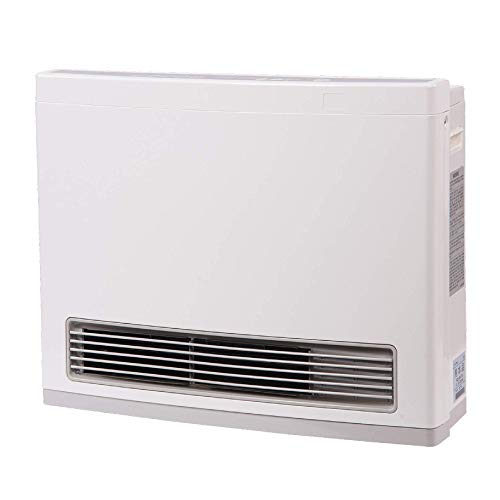
1. Best Overall: Rinnai FC824P
This is the best propane wall heater you can find on the market.
What’s amazing about Rinnai’s heater is that it includes multiple smart features such as a programmable thermostat display that lets you set the desired temperature of the room.
It’s important to mention that it has self-diagnostics, so you’ll be notified when maintenance is needed.
It has a flame failure switch and an overheat switch that cut the heater off when something goes wrong. They lower the risk of fire but do not remove it. Also, it has oxygen depletion sensors that automatically shut the unit off if oxygen levels are too low.
They even have the same model that runs on natural gas instead of propane.
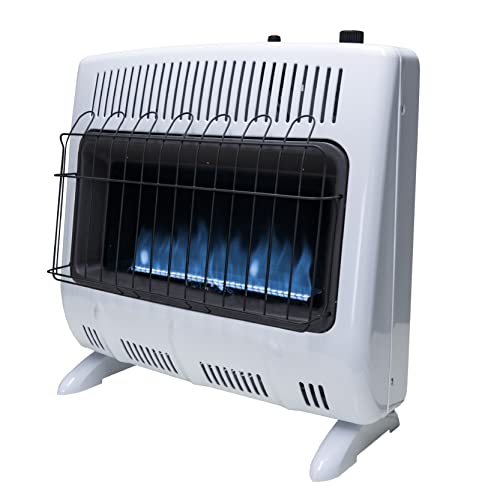
2. Efficient: Mr. Heater F299730
If I had to use one word to describe this heater it would be efficiency.
It’s very efficient and it can heat up to 750 square feet – don’t let the size fool you.
It has a built-in thermostat, so you can always control the desired temperature.
What’s awesome about this device is that you can easily move it from one room to another, and you can also attach it to the wall.
Blue flames create an even cozier feeling and it looks like you have an electric fireplace in your home.
One thing to note, it’s forbidden in Canada.
3. Smart Features: Rinnai FC510P
Of all the propane wall heaters I’ve tested – this one has the most advanced smart features.
If you’re a tech-type guy, you’ll love this propane wall heater.
It has all the safety features such as oxygen sensors and it has a programmable thermostat – you can set it to always heat your desired room’s temperature.
It has only 10,000 BTUs, so I wouldn’t recommend it for a larger home.
You can install it in offices, homes, apartments – and any other interior.
Get matched with a local HVAC technician
Repairs, installs and tune-ups. Networx matches you with vetted pros near you. Free, no obligation.
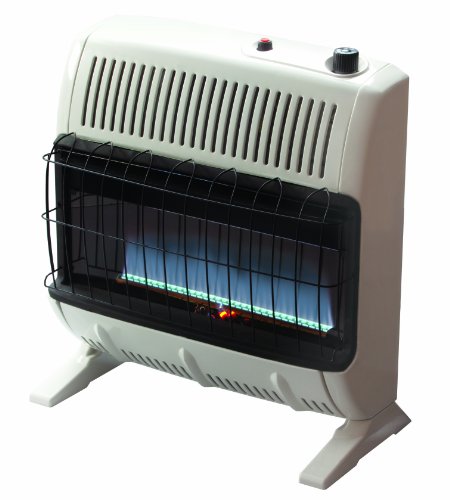
4. Powerful: Mr. Heater Blue Flame
Although this heater is smaller than average units, it’s one of the most powerful propane wall heaters.
It has 30,000 BTU and it’s suitable for larger rooms.
What you’ll love about it is that it can operate without electricity during power outages.
At 30,000 BTU an hour a 20 lb cylinder lasts about half a day. Mr. Heater lists 21.59 hours at 20,000 BTU for its smaller 20,000 BTU heater; on the same cylinder, 30,000 BTU burns through the fuel in about two thirds of that time, roughly 14 hours.
Vent-free heaters release their exhaust into the room, so keep fresh air coming in and run a carbon monoxide alarm.
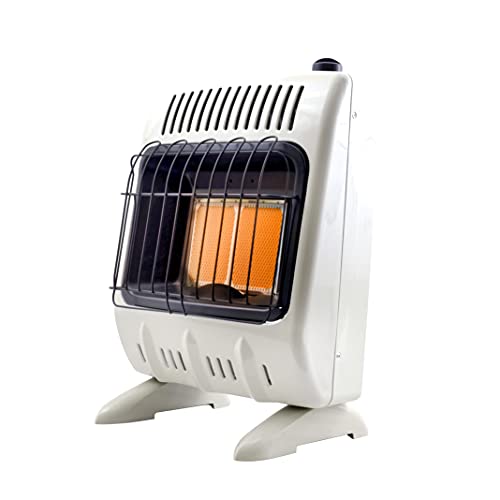
5. Advanced: Mr. Heater 30,000 BTU Vent-Free Radiant
Mr. Heater 30,000 BTU Vent Free Radiant Propane Heater (F299830)
We earn a commission if you buy through this link, at no extra cost to you.This replaces the Dyna-Glo IR18 we listed here, which Amazon no longer carries. It runs on propane and needs no electricity: the ignition runs on a battery that comes in the box.
It can produce up to 30,000 BTUs while heating rooms up to 1,000 sq. ft., by Mr. Heater’s figure.
Infrared technology radiates heat to warm objects and people first instead of releasing it into the air, which is why it feels warm faster than a convection heater.
What I advise you to buy separately is Mr. Heater’s blower fan kit (F299201), which spreads the warmth across a bigger room without much extra noise.
It comes with feet to stand it on the floor and the hardware to hang it on a wall, a built-in thermostat, and the oxygen depletion sensor that every vent-free heater needs.
6. Budget-friendly: Mr. Heater Vent-Free
This Mr.Heater model is made with a bit cheaper material, so if you’re low on budget – you should get this model.
It has some of the smart features of more expensive models – such as a low oxygen shut-off system.
What’s impressive (considering the price) is that the run time is 43 hours. Some expensive models don’t have such great operation time.
It’s important to mention this is a radiant propane heat burner.
Advantages of Propane Wall Heaters
- They don’t need gas lines built inside of your home
- Propane can cost less than electric resistance heat: at the EIA’s U.S. average of $2.638 a gallon (12 Oct 2026, taxes excluded) it costs about $29 per million BTU, against about $54 for electricity at 18.31 cents per kWh. Local prices vary
- Vent-free models release their exhaust into the room, so they are not right for every household; direct-vent models send it outside
- Many models run without electricity, so they keep working in a power outage
- About as efficient as electric heaters at the heater itself, since electric heat is also close to 100% efficient
- Easier to install than a furnace, but have a qualified installer connect the gas
- Need regular upkeep: CPSC advises a professional inspection of fuel-burning heating systems every year
- Many have a built-in thermostat
What Is The Difference Between Direct Vent and Ventless Propane Heaters?
There are two types of propane wall heaters – ventless and vented.
The main difference is that ventless heaters don’t need outside air for operation. They use oxygen from the same room they’re positioned in.
Ventless propane wall heaters usually have oxygen sensors, so they automatically shut off if the limit is reached. The sensor watches oxygen, not carbon monoxide.
On the other side, we have vented (direct-vent) safer propane heaters that work at higher elevations.
Still, I recommend you learn if you can use your propane heater indoors.
Because they vent outside, they do not put combustion gases such as carbon monoxide into your room, but they are usually harder to install.
It’s hard to tell which one is the best, although I’m an “all about the safety” type of guy – so I’d usually choose a vented propane wall heater first. Every pick above is vent-free: the direct-vent model we used to list is no longer sold on Amazon and we found no well-reviewed replacement there, so for a vented unit go through a hearth or HVAC dealer.
Which Is Better – A Vented Propane Heater Or A Ventless Propane Heater?
There are two basic types of propane wall heaters – ventless (or vent-free) and vented (or direct-vent).
Ventless heaters do not need or use outside air at all. They consume oxygen from the room they’re in and exhaust any fumes into the same room.
This is a fair concern. Vent-free heaters release carbon monoxide, nitrogen dioxide and water vapor into the room. Their oxygen depletion sensor shuts the heater off when oxygen runs low, but it does not detect carbon monoxide, so keep fresh air coming in and run a carbon monoxide alarm.
Ventless propane heaters are allowed in many places but not everywhere. Mr. Heater says unvented heaters are prohibited indoors in Canada and Massachusetts and restricted in California homes, and some cities restrict them too. Check your local rules first.
They offer some distinct advantages over vented propane heaters:
- Ventless propane heaters are easier to install
- Ventless propane heaters don’t require ducts, chimneys, or any other outside venting, making them even more energy-efficient
- Ventless propane heaters are substantially less expensive than their vented counterparts
Vented, or direct-vent, heaters, on the other hand, are often quite a bit more expensive, and people who are not concerned about the safety of a ventless propane heater will claim that direct-vent heaters do not offer any real advantages. They are also a little more difficult to install.
It cannot be denied, though, that vented heaters do not put any pollutants or noxious fumes, like carbon monoxide, into your home. And since they draw air from outside, they also will not use any oxygen from your rooms.
Direct vent heaters offer the following advantages over ventless heaters:
- They are safer – even if we understand that ventless heaters are considered safe, vented propane heaters are still better and cleaner in this regard.
- Vented heaters work at higher elevations – up to, and even over, 10,000 feet (~3050 meters)
- Vented heaters are legal and allowed for interior use in more places, including Canada and California
What Size Of Propane Wall Heater Do I Need?
The question of how many BTUs you need can be a little confusing to answer.
Ideally, you would need to factor in not just the size of your space, but the number of people on average who occupy that space, their levels of activity, the amount of insulation as well as the room or home’s building materials, outside temperature and sun exposure and more. Confused yet?
To make it simple we will break down the choices into three sizes:
- Small Spaces – up to 350 square feet
- Medium Spaces – around 500 square feet
- Large Spaces – up to 1000 square feet
If you live in an especially cold area, if your house is poorly ventilated or has little sun, or if you just like things warmer, you can move up to the next level on our guide and still enjoy efficient and cost-effective heating.
Just How Efficient And Cost-Effective Are Propane Wall Heaters?
If you are wondering how much propane a wall heater uses, this too depends a great deal on the environment and usage, but in any case, the answer is pretty easy – very, very little.
A 10,000 BTU heater burns about 0.11 gallon of propane an hour on its highest setting (10,000 BTU divided by 91,452 BTU per gallon), so a 100 gallon tank would last roughly 900 hours of running at full output. In practice the heater cycles and runs far fewer hours at full output.
📍 Recommended: In case you need to repair your other heating sources such as furnace, check out this efficient heater repair service.
Which Is Better – Radiant Or Convection Heat?
In that category, we offer two choices for ventless heaters – an infrared radiant heater, and a blue flame convection heater. The differences can be summarized thus:
- Blue Flame – circulates warm air throughout the area (convection heating), thus heating the entire room. Better for larger spaces and rooms with more activity like family rooms.
- Infrared – radiates heat from an infrared element (radiant heating), thus directly heating people and objects closer to the heater, but usually not the whole room. Better for smaller spaces and rooms with less activity like offices.
Blue flame can still be a great option for small spaces, though, especially if you want all of the space toasty warm. Infrared is great for an office or bedroom, especially where you may be close to, or in front of, the heater, and in that case, it will make you even warmer than a blue flame propane heater.
Content writer from Croatia. Dominic studies Information Science at the University of Sarajevo, which helps him research and organize his work.


