
How it is worked out
The calculator answers two questions with two published rules.
1. Blade span from the room's square feet. Multiply the room's length by its width. Then read the blade span from the room-size chart in This Old House's guide to sizing a ceiling fan: up to 75 square feet takes 29 to 36 inches, 76 to 144 takes 36 to 42, 144 to 225 takes 44 to 50, 225 to 400 takes 50 to 54, and over 400 takes 60 inches or larger. Hunter agrees at both ends: 29 to 36 inch fans for rooms under 75 square feet, and 50 inches or larger for most large bedrooms, basements and living rooms. The chart's bands touch at 144 and 225 square feet; the calculator puts a room of exactly 144 or 225 in the smaller band.
Inside each band the calculator names one size to shop for: 36, 42, 44, 52 or 54, and 60 inches. That pick is ours, not the chart's. Any fan inside the band fits the rule.
2. Downrod length from the ceiling height. Hunter gives the formula on its how to measure a ceiling fan page: "Ceiling Height - Fan Height - desired hanging height = required downrod length". Its example: a 12-foot ceiling and a 12-inch fan leave 11 feet; for a hanging height of 8 feet you need a 3-foot downrod. The calculator works in inches, then picks the nearest length from the sizes Hunter sells: 2, 6, 7, 12, 18, 24, 36, 48, 60 and 72 inches. When two lengths are equally close it takes the shorter one, so the blades sit higher, and it never picks a rod that drops the blades below 7 feet.
Low ceilings. Hunter says: "For ceiling heights less than eight feet, you'll need a low-profile ceiling fan," and "If your room has a ceiling height of nine feet or more, install a ceiling fan with a downrod." Below 9 feet the calculator therefore suggests a low-profile (flush mount) fan with no downrod, and the blade height becomes the ceiling height minus the fan's own height.
Clearances. The two sources agree on the floor and the ceiling and differ on the walls:
- Floor: blades at least 7 feet up (Hunter); 7 to 10 feet (This Old House). The calculator warns below 7 feet.
- Ceiling: at least 8 inches between blades and ceiling (both sources).
- Walls: at least 18 inches from walls or sloped ceilings (This Old House); a minimum of 30 inches from the nearest wall or door (Hunter). The plan view draws the 18 inch line. If you can, keep 30 inches.
Two more assumptions. The formula measures to the bottom of the fan, and the blades usually sit a little higher on the motor, so the real blade height is a touch more than the figure shown. And when a room is over 400 square feet and its long wall is more than twice its short wall, the calculator suggests two fans. Hunter says to consider multiple fans in larger spaces; the two-to-one trigger is our own rule of thumb.
Worked example
- 12 ft × 15 ft = 180 square feet.
- 180 falls in This Old House's 144 to 225 band: a 44 to 50 inch blade span.
- Ceiling: 12 ft × 12 = 144 inches. Fan: 12 inches. Blades wanted at 8 ft = 96 inches.
- 144 − 12 − 96 = 36 inches of downrod, which is Hunter's own 3-foot answer and a length Hunter sells.
A 44 inch fan has a 22 inch reach from its centre. From the centre of a 12 ft wide room to the side wall is 72 inches, which leaves 50 inches between the blade tips and the wall: more than either the 18 or the 30 inch clearance.
Fan size and downrod charts
Blade span by room size, from This Old House. Your room's row is highlighted.
| Room size | Blade span | Size we suggest shopping for |
|---|---|---|
| Up to 75 sq ft | 29 to 36 in | 36 in |
| 76 to 144 sq ft | 36 to 42 in | 42 in |
| 144 to 225 sq ft | 44 to 50 in | 44 in |
| 225 to 400 sq ft | 50 to 54 in | 52 or 54 in |
| Over 400 sq ft | 60 in or larger | 60 in, or two fans in a long room (our rule of thumb) |
Downrod length from Hunter's formula for a 12 inch fan with the blades at 8 feet. A different fan height changes every row: work it out above.
| Ceiling height | Formula (inches) | Downrod |
|---|---|---|
| 9 ft | 108 − 12 − 96 = 0 | None by the formula; the shortest rod, 2 in, puts the blades at 7 ft 10 in |
| 10 ft | 120 − 12 − 96 = 12 | 12 in |
| 11 ft | 132 − 12 − 96 = 24 | 24 in |
| 12 ft | 144 − 12 − 96 = 36 | 36 in |
| 13 ft | 156 − 12 − 96 = 48 | 48 in |
| 14 ft | 168 − 12 − 96 = 60 | 60 in |
| 15 ft | 180 − 12 − 96 = 72 | 72 in |
Hunter's downrod page gives a shorter rule of thumb: a 12 inch rod from 9 foot ceilings, and a 72 inch rod for a 15 foot ceiling. The formula agrees at 15 feet. At 9 feet it depends on the fan: a 12 inch rod under a 12 inch fan puts the blades at 7 feet, still within Hunter's minimum.
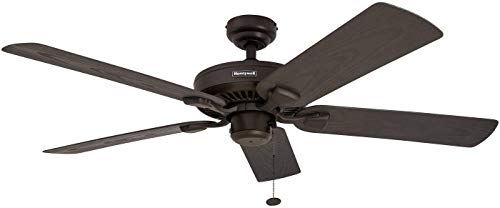
Honeywell Belmar 52-Inch Indoor/Outdoor Ceiling Fan, Five Damp Rated Fan Blades, Bronze
We earn a commission if you buy through this link, at no extra cost to you.Which way should it spin?
The switch is usually on the motor housing. Turn the fan off and let it stop before you flip it. Source: Hunter's article on ceiling fan direction for summer and winter.
Guides that go with this tool
- Ceiling fan vs standing fanComparison
- 10 best outdoor ceiling fansBuying guide
- 6 best high CFM ceiling fansBuying guide
- Industrial ceiling fans 101Buying guide
- 9 best bladeless ceiling fans with lightBuying guide
- 50 unique ceiling fansBuying guide
FAQ
What size ceiling fan do I need for a 12 by 12 bedroom?
A 12 by 12 foot room is 144 square feet. This Old House puts rooms of 76 to 144 square feet at a 36 to 42 inch blade span. Its next band, 44 to 50 inches, also starts at 144 square feet, so a 44 inch fan suits that room too.
How long a downrod do I need for a 10 foot ceiling?
Use Hunter's formula: ceiling height minus fan height minus the blade height you want. A 10 foot ceiling is 120 inches. Take away a 12 inch fan and an 8 foot (96 inch) blade height and you get a 12 inch downrod. Check your fan's own height on its spec sheet, because it changes the answer.
Which way should a ceiling fan spin in summer?
Counterclockwise, looking up at the fan, so it pushes air down onto you. In winter, switch it to clockwise on low so it pulls air up and moves the warm air trapped near the ceiling back out and around the room.
Sources
- Blade span by room size, and the 7 to 10 ft, 8 in and 18 in clearances: This Old House, How to size up a ceiling fan.
- The downrod formula and example, the low-ceiling rules, the 7 ft, 8 in and 30 in clearances, fan housing heights and the advice on multiple fans: Hunter, How to measure a ceiling fan.
- Downrod lengths sold, and the 9 ft and 15 ft rule of thumb: Hunter, Ceiling fan downrods.
- Spin direction: Hunter, Ceiling fan direction for summer and winter.
- Ours, not a source's: the one size suggested inside each band, and the two-fan trigger (over 400 sq ft with the long wall more than twice the short wall).
Last checked 20 October 2026. The calculator does not store anything you type.