

Ceramic heaters warm the air and suit bigger rooms; radiant (infrared) heaters warm people and objects directly and suit spot heating or readers who want Wi-Fi control. At the same wattage neither costs less to run, because both turn nearly all their power into heat.

You may be considering buying a ceramic or radiant heater and don’t want to rush.
Choosing between those two was the most frustrating thing I’ve done.
As I know how hard it is to choose between them, I prepared a guide for you to choose which one fits your needs.
Let’s first talk about their differences, and then I’ll cover the benefits and drawbacks of ceramic and radiant heaters.
Difference Between Ceramic and Radiant Heaters?
The main difference between these two is the principle of how they work and distribute heat.
Ceramic heaters work on the convection principle, which means they heat up the air with ceramic and then distribute the warm air throughout the home.
There are two different models: regular models and fan-aided models.
I would always recommend fan-aided models for bigger rooms.
Radiant heaters don’t heat up the space like ceramic heaters; they heat up “things.”
You should consider buying one if you’re looking for “laser-focused” heating.
Also, they come in two variations: wall-mounted and stand-and-swivel.
Pick the appliance or type its watts, set the hours and your state: the cost per hour, per night and per month, before you buy.
Benefits of Ceramic Heaters

Portable
Ceramic heaters are light and easy to carry from room to room, but let one cool down before you pick it up.
You can always heat multiple rooms; ceramic heaters don’t take long to heat the whole room.
Safe
Most ceramic heaters nowadays have overheating protection, which lowers the risk, but any heater can start a fire if it sits too close to things that burn. Keep it at least 3 feet from curtains, furniture and bedding.
Also, specific models have protection grills that protect your kids and pets from burning themselves.
Economic
A ceramic heater uses as much electricity as its wattage says: a 1,500 watt model draws 1.5 kilowatts, the same as any other 1,500 watt heater. At the U.S. average residential price of 18.31 cents per kWh (July 2026), that is about 27 cents an hour.
A lower-wattage model, or one with a thermostat, will keep the bill down.
You should look at the most energy-efficient space heaters on the market.
Get matched with a local HVAC technician
Repairs, installs and tune-ups. Networx matches you with vetted pros near you. Free, no obligation.
Powerful
Ceramic heaters usually top out at 1,500 watts, like most smart space heaters, but they can still heat a room quickly.
In my experience they warm a room faster than radiant heaters do, though they will not heat a whole house.
If you can’t choose the right ceramic heater for your home, I have an honest recommendation that I have used for more than three years.
Recommended Ceramic Heater: Lasko 751320
This is the best and most quality ceramic heater – no wonder it’s so popular on the market.
First, I must mention the auto-off timer, which shuts the heater off after the time you set.
I love that it has a thermostat.
It has overheating protection and is easy to move around all the rooms because of its carry handle.
However, Lasko lists its 23-inch 1,500 watt tower heater for rooms up to 150 sq. ft., so use it in a small to medium room.
I highly recommend this portable space heater if you’re on a budget.
What You Might Not Like About Ceramic Heaters
Ceramic heaters have a lot of advantages, but they are not perfect and lack a couple of things.
The first thing you might not like is that you shouldn’t use them as your primary heating source.
Yes, they are powerful, but they’re meant to be your second heating source.
The second thing you probably won’t like is the temperature settings.
The problem is that you have 5-8 different temperatures that you can choose from, and you can’t choose the temperature you might want.
Another thing that you may consider a weakness of ceramic heaters is that they only work best in spaces with good insulation and minimal outside airflow. If the space has poor insulation or cold air is flowing in, ceramic heaters may struggle to warm up the space.
Radiant heaters warm you directly instead of the air, so drafts and poor insulation matter less.
Benefits of Radiant Heaters
Space Friendly
Radiant heaters usually take up very little space or can be wall-mounted, so they won’t even take any of your floor space.
They can fit into your household design because of their size.
Clean Heating
They don’t produce any smoke or any smell because they run only off electricity.
They don’t produce ash or dust, so you don’t have to clean them every now and then to maintain them.
This might be the most significant benefit of radiant heaters if you have a dust allergy.
Smart
Some radiant heaters even have a WiFi option so that you can control them over your smartphone.
You can control everything, including temperature, automatic shutdown, speed level, and more, just by using your phone.
I believe radiant heaters became popular because of their advanced technology.
Let me tell you more about the best radiant heater on the market.
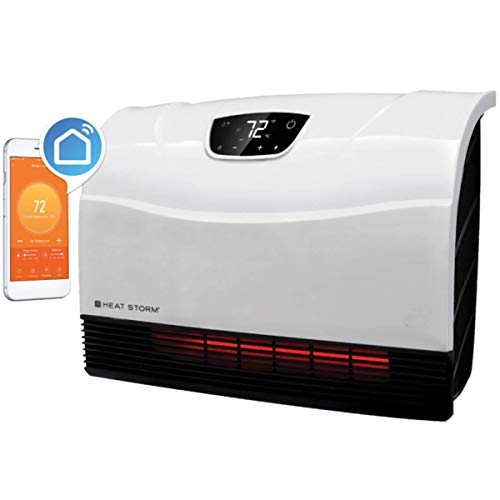
Recommended Radiant Heater: Heat Storm HS-1500-PHX
Heat Storm HS-1500-PHX-WIFI Infrared Heater, Wifi Wall Mounted
We earn a commission if you buy through this link, at no extra cost to you.This is one of the smartest heaters with built-in Wi-Fi technology that allows you to control everything through your smartphone.
It’s a wall-mounted model so it won’t take any of your floor space. It makes it even safer for kids and pets.
You can even control it with your voice, so you have to integrate it with Alexa or Google Assistant – this tells you a lot about its advanced technology.
If you’re interested in this fantastic radiant heater, you should find five reasons to buy a Heat Storm heater.
The Downside of Radiant Heaters
Radiant heaters are a great solution, but they have some disadvantages that I dislike and bother me.
What frustrates me is how they’re not as durable as ceramic heaters – I’m not talking about all models, but most of them.
Also, I noticed that ceramic heaters heat the room much faster than radiant heaters.
They’re very good, but these two things are what I would call the “downside” of radiant heaters.
So, Which One Is Better?
As you’ve learned in this article, they both have their own advantages and downsides.
If you want to heat a bigger room, use ceramic heaters.
However, if you’re a tech guy and like innovative features – you should go with radiant heaters.
Choose carefully based on your needs and your own requirements. Only in that way will you know which one fits you better.
If you have other issues with your heating, you can always get professional heating services to inspect your home, or feel free to call an HVAC technician by submitting a form here.
Content writer from Croatia. Dominic studies Information Science at the University of Sarajevo, which helps him research and organize his work.


