

No fan chills air the way an AC does. A fan moves air across your skin, and the wind chill makes you feel cooler. Only an evaporative cooler lowers the air temperature, and only in dry air: our pick is the Hessaire MC18M (1,300 CFM, up to 500 sq ft). Outdoors, use a misting fan like the Lasko 7050 Misto. In humid weather, pick a high-airflow fan like the Lasko Wind Curve T42950 (634 CFM).




No fan makes air cold the way an air conditioner does. A fan moves air across your skin, and that breeze carries heat away, so you feel cooler while the room stays the same temperature. Three kinds get you closest to cold air: an evaporative cooler, which really does lower the air temperature in dry climates, a misting fan for outdoors, and a high-airflow fan or air circulator for everywhere else. Our picks for each are below.
Why a fan feels cold but does not cool the room
ENERGY STAR puts it plainly in its ceiling fan usage tips: "Ceiling fans cool people, not rooms." The airflow creates a wind-chill effect that makes you feel cooler. The same physics applies to any fan you point at yourself.
The Department of Energy's Energy Saver guide says ceiling fans cool by creating a wind chill effect, and that running one lets you turn the thermostat up about 4°F with no loss in comfort. The flip side is that a fan in an empty room does nothing useful, so turn it off when you leave. Your air conditioner's fan-only setting works the same way, as our guide to AC modes explains.
The same DOE guide names the one fan-like machine that does lower the air temperature. Evaporative coolers, or swamp coolers, cool outdoor air with evaporated water, and DOE says they work well where the air is hot and humidity is low.
Pick the appliance or type its watts, set the hours and your state: the cost per hour, per night and per month, before you buy.
Which kind fits your climate
- Hot and dry air: an evaporative cooler
- A patio, deck or yard: a misting fan on a garden hose
- Humid air, or a closed-up room: a high-airflow fan or air circulator
Fan airflow is listed in CFM, cubic feet of air per minute. A bigger number means a stronger breeze, but many makers do not publish it, and some use their own measures. We give each maker's own figures below, as of October 2026, and say where a figure is missing. Check the listing before you buy, because models change.
Evaporative cooler: the only one that lowers the air temperature
An evaporative cooler pulls air through a water-soaked pad. As the water evaporates, it takes heat out of the air. Hessaire's evaporative cooler FAQ says this typically lowers the air temperature by 15 to 25°F, with the best results at 10 to 30 percent humidity and reduced effect above 60 percent. It also adds moisture to the room, which is why it suits dry climates and struggles in humid ones.
Hessaire MC18M
Hessaire MC18M Portable Evaporative Cooling Fan
The Hessaire MC18M is the maker's 1,300 CFM model, rated for rooms, patios and workshops up to 500 square feet. It has a 4.8-gallon water tank, draws 85 watts (0.7 amps) and weighs 16 lb, with casters to roll it around.
Two rules from the MC18 owner's manual matter indoors. Place the cooler in front of an open window or door for fresh intake air, and make sure the room has another opening the air can leave through. And do not use the garden hose or continuous-fill attachment indoors, so fill the tank by hand.
Hessaire's FAQ adds that if you trap the air the way you would with an AC, the room turns humid and uncomfortable. It is not a machine for a sealed bedroom in a humid climate. For more sizes, see our evaporative air cooler guide.
Get matched with a local HVAC technician
Repairs, installs and tune-ups. Networx matches you with vetted pros near you. Free, no obligation.
Misting fan: for the patio, not the living room
A misting fan sprays a fine mist into its airflow. The droplets evaporate around you, which is the same principle as an evaporative cooler, so it also works best in dry air. It needs a hose and leaves nearby surfaces damp, which makes it an outdoor tool.
Lasko 7050 Misto
Lasko 7050 Misto Outdoor Misting Fan
Lasko's Misto 7050 page lists up to 350 CFM, three speeds and powered louvers that sweep the air and mist across a wider area. The included 9-foot hose connects to a standard garden hose, and a shut-off valve sets how much mist you get.
It draws 72 to 90 watts and runs at 51.7 to 57.6 dBA. For use around water it has an in-line GFCI and a grounded three-prong plug. It is a 15-inch fan with a pivoting head, but no oscillation and no timer.
Our outdoor misting fan picks cover larger models.
High-airflow fans: the right choice in humid weather
When the air is already humid, adding water does little. The strongest breeze you can aim at yourself is then the best you can do without an air conditioner. An air circulator throws a tight column of air across the room, while a tower fan spreads a wider, gentler stream. Our air circulator vs fan comparison goes through the difference, and our high CFM box fans give the most airflow for the money.
Lasko Wind Curve 42" T42950: the most airflow stated
Lasko Oscillating Tower Fan with Fresh Air Ionizer
Lasko's T42950 page rates this tower fan at up to 634 CFM, the highest figure among the indoor fans here. It has three speeds, 45 degrees of oscillation, a 7.5-hour auto-off timer, a remote, a carry handle and an ionizer.
Lasko measures it at 39 dBA on low and 55.4 dBA on high, and it draws 40 to 48 watts. At 48 watts, eight hours costs about 7 cents at the August 2026 US average of 18.16 cents per kWh (EIA, preliminary).
Vornado 630: compact air circulator
Vornado 630 Mid-Size Whole Room Air Circulator Fan
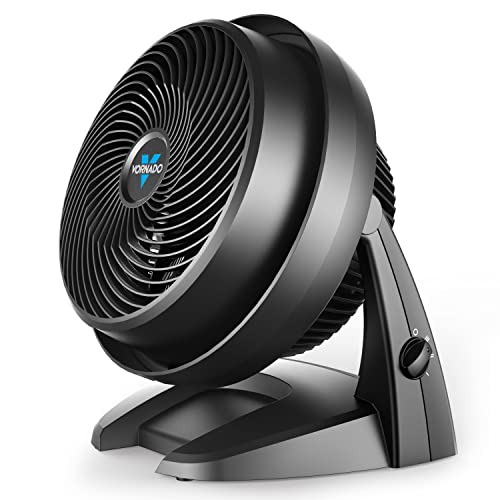
The Vornado 630 is a medium air circulator that Vornado says moves air up to 70 feet, and the maker pitches it at small and midsize rooms. It has three speeds on a dial, a pivoting head you can aim across the room or up at the ceiling, and a removable grille for cleaning. Vornado backs it with a five-year guarantee.
Vornado lists no CFM, wattage or noise figure on the 630's page, so we cannot compare it on those numbers. Choose it if you want air moved around a whole room rather than a breeze in one spot.
Dyson Cool AM07: bladeless tower
Dyson Cool AM07 Air Multiplier Tower Fan
The Dyson AM07 has 10 speed settings, up to 70 degrees of oscillation, a night mode that uses its quietest settings and a curved, magnetic remote. Dyson says it projects up to 132 gallons of air a second. That figure counts the surrounding air the fan pulls along, so it does not compare directly with a CFM rating.
It stands 39.6 inches tall and weighs 6.3 lb. Dyson says it has no fast-spinning blades, which also makes it easy to clean. The page lists no wattage or noise figure, and Dyson's own footnote reads "Fan; not air conditioning unit."
At $399.99 on Dyson's store, against $89.99 for the Lasko, you are paying for the bladeless design rather than for more stated airflow. Dyson's store showed it out of stock in late October 2026.
Honeywell QuietSet HYF290B: bedroom features
Honeywell QuietSet Whole Room Tower Fan HYF290B
Honeywell's QuietSet HYF290 page lists eight speed settings, from a Power Cool setting at the top to a Sleep setting at the bottom, with oscillation and a remote that stores in a nest on the fan. It has an auto shut-off timer of 1, 2, 4 or 8 hours and five light-dimming options for the display. It measures 15.75 inches wide by 39.8 inches tall and assembles without tools.
Honeywell publishes no CFM, wattage or decibel figure for it on that page. Treat it as a bedroom fan chosen for its sleep-friendly controls, not for raw airflow.
JISULIFE Neck Fan 3: personal cooling on the move
A neck fan aims air at your neck and face from a few inches away. JISULIFE's Neck Fan 3 page lists 78 air outlets, five speeds, a maximum wind speed of 3.5 meters per second and a 4,000 mAh battery rated for up to 13.5 hours. It weighs 270 grams.
It is not silent. JISULIFE rates it at 51 to 66 dB, and because it sits next to your ears, you will hear it. It suits a commute, yard work or a hot office, not a whole room.
Compare the picks
| Pick | Type | Airflow (maker) | Coverage or reach | Noise | Power |
|---|---|---|---|---|---|
| Hessaire MC18M | Evaporative cooler | 1,300 CFM | Up to 500 sq ft | Not stated | 85 W |
| Lasko 7050 Misto | Outdoor misting fan | 350 CFM | Not stated | 51.7 to 57.6 dBA | 72 to 90 W |
| Lasko T42950 | Tower fan | 634 CFM | Not stated | 39 to 55.4 dBA | 40 to 48 W |
| Vornado 630 | Air circulator | Not stated | Moves air up to 70 ft | Not stated | Not stated |
| Dyson AM07 | Bladeless tower fan | 132 gallons a second (Dyson's measure) | Not stated | Not stated | Not stated |
| Honeywell QuietSet HYF290B | Tower fan | Not stated | Not stated | Not stated | Not stated |
| JISULIFE Neck Fan 3 | Neck fan | 3.5 m/s wind speed | Personal | 51 to 66 dB | 4,000 mAh battery, up to 13.5 h |
What it costs to run
Fans are cheap to run. Multiply the watts by the hours, divide by 1,000 to get kWh, then multiply by your electricity rate. At the US average of 18.16 cents per kWh:
- Lasko T42950 at 48 W: about 0.9 cents an hour, 7 cents a night (8 hours)
- Hessaire MC18M at 85 W: about 1.5 cents an hour, 12 cents a night
- Lasko 7050 Misto at 90 W: about 1.6 cents an hour
Our cost to run calculator works it out for any wattage and your state's rate. If you have a ceiling fan, ENERGY STAR says to run it counterclockwise in summer. When fans stop being enough, our list of alternatives to air conditioners covers the next steps.
Frequently asked questions
Is there a fan that blows cold air like an AC?
No. A fan moves air and makes you feel cooler through wind chill, but it does not lower the room temperature. Even Dyson footnotes its AM07 tower fan as a fan, not an air conditioning unit. The closest thing is an evaporative cooler, which Hessaire says typically lowers air temperature by 15 to 25 degrees F, but only when the air is dry.
Do evaporative coolers work in humid weather?
Not well. Hessaire says its coolers perform best at 10 to 30 percent humidity, still work at 30 to 50 percent, and lose effect above 60 percent. They also add moisture to the room and need an open window or door for fresh air and another for the air to leave. In a humid climate, a high-airflow fan is usually the better buy.
Does a fan cool a room when nobody is in it?
No. ENERGY STAR says ceiling fans cool people, not rooms, and advises turning the fan off when the room is empty. The same holds for any fan: the cooling comes from air moving across your skin. A fan left running in an empty room only uses electricity.
Can I put ice in an evaporative cooler?
Only if your model is designed for it. Hessaire says some coolers have an ice compartment, and ice gives a temporary boost in cooling that fades as it melts. Check your manual first, and do not put ice directly in the main tank unless the manual says so. Humidity, not ice, sets how much an evaporative cooler can do.
How much does it cost to run a fan all night?
Very little. The Lasko T42950 tower fan draws up to 48 watts, so eight hours uses about 0.38 kWh, or about 7 cents at the August 2026 US average of 18.16 cents per kWh. The 85 watt Hessaire MC18M evaporative cooler costs about 12 cents for the same eight hours. Your own rate may be higher or lower.
Founder of Home Caprice. Benas started the site to simplify HVAC after dealing with the heating and cooling in his first apartment.


