

Pick a ceramic heater to warm the air in a closed room and an infrared heater to warm you directly when you sit in one spot in a drafty room. At 1,500 watts both make the same heat and cost the same to run, about 27 cents an hour at the U.S. average price. Many cabinet infrared heaters also blow warm air, so the gap is smaller than the labels suggest.

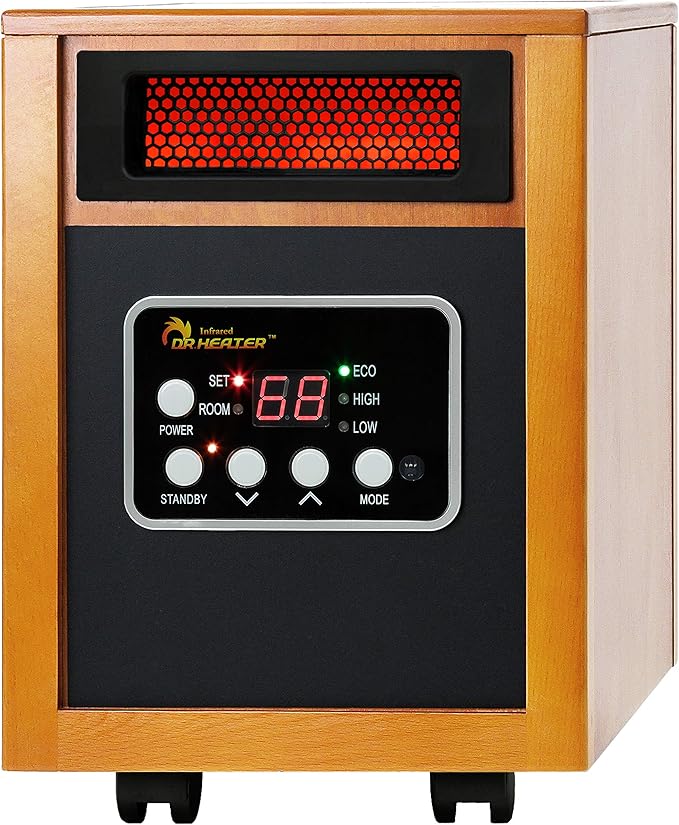
Pick a ceramic heater if you want to warm the air in a closed room, and an infrared heater if you sit in one spot in a drafty room and want the heat aimed at you. At 1,500 watts both put out the same heat and cost the same to run. Many cabinet heaters sold as "infrared" also blow warm air, so the gap is smaller than the labels suggest.
Ceramic vs infrared at a glance
We compared one model of each type, the Lasko CT24950 ceramic tower and the Dr. Infrared DR-968, using only the makers' product pages and manuals as of October 2026. Where a maker does not give a figure, the table says so.
| Spec | Lasko CT24950 (ceramic) | Dr. Infrared DR-968 (infrared) |
|---|---|---|
| How it makes heat | Ceramic element; a two-speed fan blows out the heated air (Lasko manual) | Infrared quartz tube plus PTC ceramic element, with a blower (Dr. Infrared manual) |
| What it heats firstCPSC staff: fan heaters create warm air; radiant heaters warm the surfaces in front of them | The air, which then mixes through the room | Both: Dr. Infrared says it combines infrared heat with convection heat |
| Power at the wall | 750 to 1,500 W | 1,000 or 1,500 W, plus ECO |
| Heat output on highEIA counts electric resistance heat as 100% efficient | Same as any 1,500 W heater, about 5,100 BTU an hour | 5,200 BTU per Dr. Infrared; the same 1,500 W |
| Time to feel warm | Not stated by the maker | "Heat a room after a few minutes of operation" (Dr. Infrared manual) |
| Fan and noise | Fan; under 40 dB (Lasko) | Blower; 39 dB (Dr. Infrared) |
| Surface temperature | Cool-touch housing, but the manual warns the heater is hot when in use | "Cool-Touch" cabinet, with the same hot-surface warning in the manual |
| Maker's room sizeSizing rule: 10 W per sq ft, so about 150 sq ft at 1,500 W (Stelpro) | Up to 300 sq ft | "A large room" as a supplemental zone heater; no square footage |
| Safety features | Tip-over switch, thermal overload protector, child lock; ETL listed | Tip-over switch, overheat and blocked-intake cut-offs; UL certified |
| Running cost on high1.5 kWh at 18.16 cents per kWh (EIA, August 2026, preliminary) | About 27 cents an hour | About 27 cents an hour |
| Element lifespan | Not stated by the maker; 3-year limited warranty | Quartz tube 20,000 hours and up, PTC element 80,000 hours and up; 3-year limited component warranty |
| Weight and upkeep | 5.0 lb; vacuum the intake grills every two weeks | 18 lb (manual) to 20 lb (product page); clean the rear filter once a month |
| Best for | Closed bedrooms and offices where you want the air warm and a light heater to carry between rooms | A heater that stays in one cold room and mixes direct infrared warmth with blown air |
| Buy | Check price | Check price |
Figures from the makers' own pages and manuals: lasko.com, images.salsify.com, drheaterusa.com, cdn.shopify.com, cpsc.gov, eia.gov, stelpro.com.
The rows that differ are the ones about feel, weight and upkeep. The rows about heat and cost come out even, for reasons the next sections explain.
How each one makes heat
Ceramic heaters warm the air
A ceramic heater is a fan heater. A fan pushes air past a hot ceramic element and blows it into the room. The Lasko CT24950 instruction manual lists two fan speeds and notes that the display does not show "the temperature of the heated air being emitted by the heater." The warm air then mixes through the room, which is why a ceramic tower suits a space with the door shut.
Infrared heaters warm what is in front of them
A radiant heater works more like the sun. A Consumer Product Safety Commission staff report on radiant heaters puts the difference plainly: most fan-forced and convection heaters create warm air, while radiant heaters mainly give off infrared radiation that strikes the objects in front of the heater and warms their surfaces. That is why you can feel it on your skin while the air around you is still cool.
Presto describes its 1,000-watt HeatDish parabolic heater this way: it is designed to heat people and objects directly, "without first heating the air space around them," according to the Presto HeatDish manual. Presto's product page also says it is not designed to heat the air of large areas.
Most "infrared" cabinet heaters do both
The wood-look cabinet heaters most people picture when they hear "infrared" are hybrids. The Dr. Infrared DR-968 manual says the heater "combines the energy efficiency of infrared heat with the comfort of convection heat," and its spec list includes a multi-blade blower. Inside sit an infrared quartz tube and a PTC (positive temperature coefficient) ceramic element, the same element family as a ceramic heater.
So the real choice is between three designs: a ceramic fan heater, an infrared cabinet heater that also blows air, and an open radiant heater such as a dish or a glowing quartz panel. If you want the "heats you, not the air" effect, the open radiant design delivers the most of it.
Get matched with a local HVAC technician
Repairs, installs and tune-ups. Networx matches you with vetted pros near you. Free, no obligation.
Heat output and running cost: a tie
You will often read that infrared heaters are more efficient. They are not. The U.S. Energy Information Administration counts electric resistance heating as 100% efficient, because all the electricity becomes heat, and it lists 1,500 watts (about 5,100 BTU an hour) as the most typical size. Ceramic and infrared heaters are both electric resistance heaters.
The two models we compared both top out at 1,500 watts. Lasko lists the CT24950 at 750 to 1,500 watts; Dr. Infrared lists the DR-968 at 1,000 or 1,500 watts and rounds its output to 5,200 BTU. At the same setting, neither makes more heat than the other.
Running cost follows the watts. On high, a 1,500-watt heater uses 1.5 kWh an hour. At the U.S. average residential price of 18.16 cents per kWh (EIA, August 2026, preliminary), that is about 27 cents an hour, or $2.18 for eight hours. Our space heater running cost calculator uses your own state's rate.
Presto says the HeatDish costs a third less to run than 1,500-watt heaters. That is because it draws 1,000 watts, so it also makes a third less heat. An infrared heater saves money only when its direct warmth lets you set the thermostat lower or heat one chair instead of the whole room.
Which one feels warmer, and where
Room size matters more than the element. Stelpro, a maker of electric heaters, gives the common sizing rule of 10 watts per square foot for an 8-foot ceiling, so 1,500 watts covers about 150 square feet. Lasko puts the CT24950's maximum coverage at 300 square feet on its CT24950 product page. The DR-968 manual says only that it "can heat up a large room" as a supplemental zone heater. For more space than that, our guide to heating a large room covers the sizing math.
A ceramic heater is the better fit when the room is closed and you move around in it, because it warms the air you walk through. An open radiant heater is the better fit when you sit still in one spot, such as a desk in a cold basement, because it warms you directly rather than the air of the whole room. Presto says its dish keeps you warm "even in a large, chilly room or open area." An infrared cabinet heater like the DR-968 sits between the two.
On speed, the makers say little. Dr. Infrared's manual says the DR-968 is "designed to heat a room after a few minutes of operation." Lasko gives no heat-up time for the CT24950.
Noise, weight and upkeep
A common claim is that infrared heaters are silent and ceramic heaters are loud. That holds for an open radiant heater, but not for cabinet models with a fan. Both of our examples have one. Lasko says the CT24950 runs at under 40 dB, and the Dr. Infrared DR-968 product page gives 39 dB. On paper, that is a draw.
Weight is a clearer difference. The CT24950 weighs 5.0 pounds per Lasko. The DR-968 weighs 18 pounds in its 2024 manual and 20 pounds on its product page. If you plan to carry the heater from room to room every day, the ceramic tower is the easier one to live with.
Both need cleaning. Lasko's manual says to vacuum the CT24950's intake grills every two weeks. Dr. Infrared asks you to clean the DR-968's rear filter once a month, or when you see dust on it. Dr. Infrared rates the DR-968's quartz tube at 20,000 hours and up and its PTC element at 80,000 hours and up. Lasko does not state an element life. Both makers give a 3-year limited warranty.
Safety: hot surfaces, tip-overs and listings
The element temperature is where the two types really differ. The CPSC staff report notes that heaters that create warm air cannot heat an object in the air stream above the exhaust temperature, typically 100 to 200°C. A radiant heater can keep heating a surface until it gets close to the element's own temperature. UL's room heater standards define a radiant heater as one with a visibly glowing element of at least 650°C, and the report gives paper's ignition point as 233°C. That is why clearance matters even more with an open radiant heater.
Do not count on any housing being safe to touch. Lasko lists a cool-touch housing and Dr. Infrared a "Cool-Touch" cabinet, yet both manuals warn that the heater is hot when in use and that bare skin should not touch hot surfaces.
Both example models list the two shut-offs we look for. The CT24950 manual describes a tip-over switch and a thermal overload protector; after an overheat you unplug the heater and wait 10 minutes before restarting it. The DR-968 manual describes a tip-over switch, an overheat cut-off and a second cut-off for a blocked air intake. Lasko lists the CT24950 as ETL listed; Dr. Infrared says the DR-968 is UL certified.
The rest is the same for either type. Portable heaters, including electric space heaters, were involved in an average of 1,600 fires, 70 deaths and 150 injuries a year from 2020 to 2022, according to CPSC's 2026 winter safety release. CPSC's rules:
- Keep the heater at least three feet from drapes, furniture and bedding.
- Plug it straight into a wall outlet, never an extension cord or power strip.
- Turn it off when you sleep.
- Buy one with the seal of a recognized testing lab such as UL.
Our safest space heaters list starts from the tip-over and overheat features.
The two models we compared
Ceramic: Lasko Ellipse CT24950
Lasko Ellipse 24-Inch Ceramic Tower Heater with Tip-Over Switch, CT24950
We earn a commission if you buy through this link, at no extra cost to you.A 24-inch oscillating ceramic tower with three heat settings, an adjustable thermostat with Eco and Sleep modes, a 12-hour timer, a remote and a child lock. Lasko lists a tip-over switch, overheat protection, cool-touch housing, ETL listing, up to 300 square feet of coverage and a 3-year limited warranty. It weighs 5.0 pounds. Lasko does not list the cord length.
Infrared: Dr. Infrared DR-968
A cabinet heater with an infrared quartz tube, a PTC element and a blower, running at 1,000 or 1,500 watts with an ECO mode. Dr. Infrared lists tip-over and overheat protection, UL certification, a 39 dB rating and a 3-year limited component warranty. The manual adds the blocked-intake cut-off and a 1 to 12 hour timer. Our infrared heater buying guide compares it with two other infrared models.
Which one should you buy
Buy a ceramic heater if you want to warm a closed bedroom or office, move the heater often, or want the lighter and simpler option. Buy an infrared heater if you sit in one place in a room that never warms up, such as a drafty den, a basement or a garage corner, and want the heat aimed at you rather than at the room. For the strongest radiant effect, choose an open dish or quartz design over a cabinet.
If you want no fan at all, look at an oil-filled radiator instead. De'Longhi, for example, describes its TRH0715 oil-filled radiator as having "no fan to stir up dust, pollen and dander," and our ceramic vs oil-filled heater comparison covers that trade-off. And if you are weighing a ceramic heater against a radiant panel or dish rather than an infrared cabinet, see our ceramic vs radiant heater guide.
Frequently asked questions
Is an infrared heater more efficient than a ceramic heater?
No. The U.S. Energy Information Administration counts electric resistance heating as 100% efficient, because all the electricity becomes heat, and both ceramic and infrared heaters are electric resistance heaters. At 1,500 watts each makes the same heat and costs about 27 cents an hour at the August 2026 U.S. average price. An infrared heater saves money only if its direct warmth lets you turn the thermostat down.
Which is safer around kids and pets, ceramic or infrared?
Neither is safe to touch. The Lasko CT24950 and Dr. Infrared DR-968 manuals both warn that the heater is hot when in use. A CPSC staff report notes that open radiant heaters have glowing elements of at least 650°C under UL's definition and can heat nearby objects far more than warm air can. Choose a model with a tip-over switch, overheat protection and a UL or ETL listing, and keep three feet of clearance.
Is a quartz heater the same as an infrared heater?
Mostly, yes. Quartz is the most common infrared element: a heating wire inside a quartz tube or bulb. The Dr. Infrared DR-968 pairs an infrared quartz tube with a PTC ceramic element and a blower, and Dr. Infrared rates the quartz tube at 20,000 hours and up and the PTC element at 80,000 hours and up. A quartz heater draws the same 1,500 watts as a ceramic one and makes the same heat.
Which is quieter, a ceramic or an infrared heater?
It depends on the fan, not the element. Lasko rates the CT24950 ceramic tower at under 40 dB and Dr. Infrared rates the DR-968 infrared cabinet heater at 39 dB, because both have fans. If you want no fan noise at all, an oil-filled radiator is the usual choice; De'Longhi describes its TRH0715 as having no fan to stir up dust, pollen and dander.
Can one 1,500-watt heater warm a whole room?
A small to medium one. Stelpro's sizing rule is 10 watts per square foot for an 8-foot ceiling, so 1,500 watts covers about 150 square feet. Lasko lists up to 300 square feet for the CT24950, and Dr. Infrared calls the DR-968 a supplemental zone heater for a large room. In a bigger or drafty space, put the heater near where you sit, or use our large-room guide.
Founder of Home Caprice. Benas started the site to simplify HVAC after dealing with the heating and cooling in his first apartment.


