

Our pick is the Dreo Atom One, a 1,500-watt heater with tip-over and overheat shut-offs, set close to where you sit. No plug-in heater warms a whole large room: at 10 watts per square foot, 1,500 watts covers about 150 sq ft. For more, you need a 240-volt heater like the Dr. Infrared DR-966, or vent-free propane in a ventilated garage or workshop.
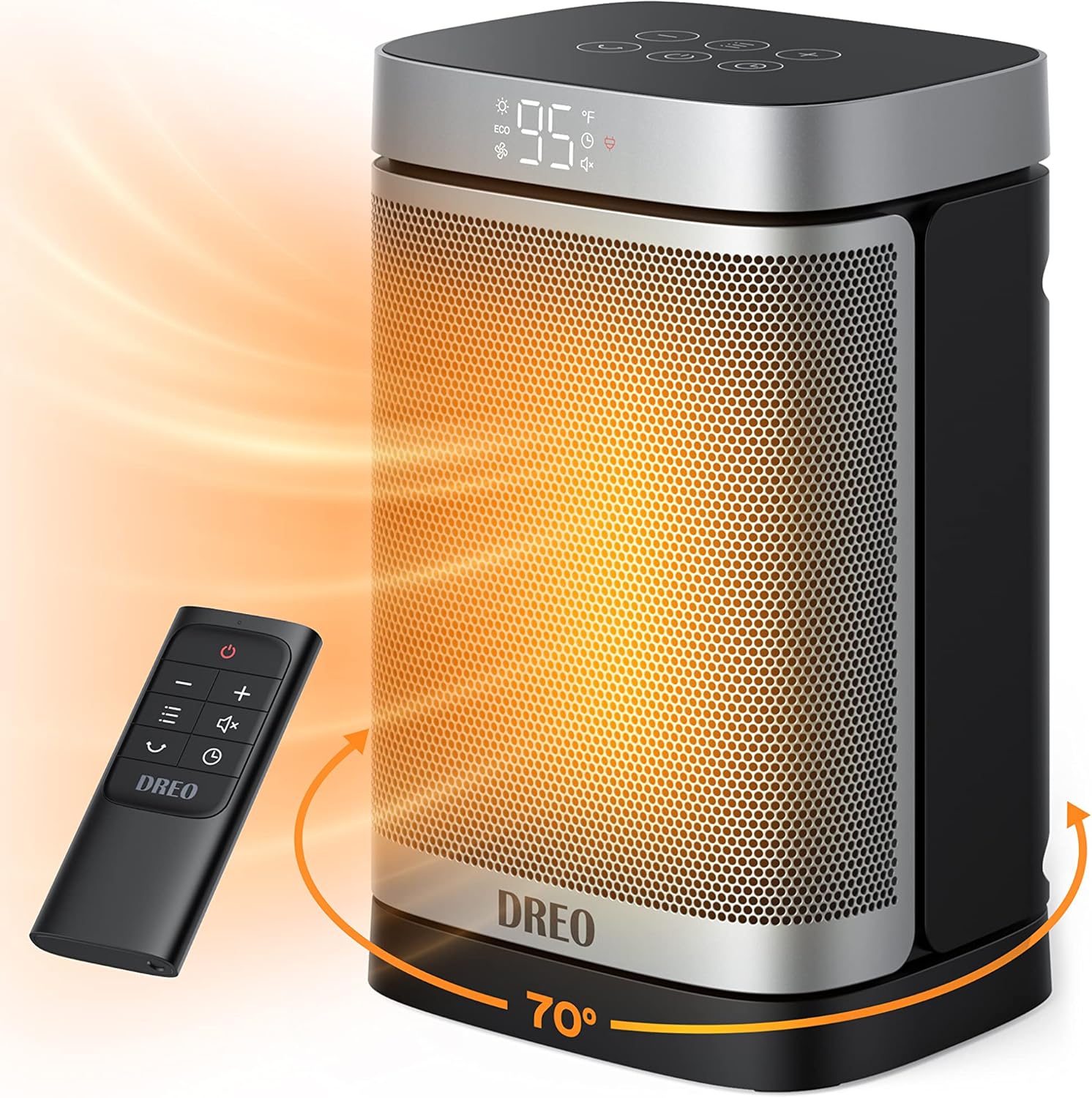


No plug-in space heater can warm a whole large room. By the standard rule of 10 watts per square foot, the 1,500 watts a regular outlet allows covers about 150 square feet. For a living room, our pick is the Dreo Atom One, set close to where you sit. For a garage, basement or workshop that needs real heat, step up to a 240-volt heater like the Dr. Infrared DR-966, or a vent-free propane heater in a ventilated space that nobody sleeps in.
How much heater a large room needs
Stelpro, a maker of electric heaters, gives the sizing rule most of the industry uses: multiply the floor area by 10 to get the watts. That holds for 8-foot ceilings. For higher ceilings Stelpro uses 1.25 watts per cubic foot, and it suggests adding a little for poor insulation or big windows.
A plug-in heater stops at 1,500 watts. At 120 volts that is 12.5 amps, most of what a common 15-amp circuit carries. Here is what the rule asks for in rooms people call large:
- 12 by 12 feet (144 sq ft): about 1,440 watts, so one plug-in heater
- 15 by 20 feet (300 sq ft): about 3,000 watts, so two heaters on separate circuits
- 20 by 20 feet (400 sq ft): about 4,000 watts, so three heaters or another heat source
- 24 by 24 feet (576 sq ft): about 5,760 watts, so a 6,000-watt 240-volt heater
Our room size heater calculator works this out for your room, ceiling height included.
Running cost scales the same way. A 1,500-watt heater on high uses 1.5 kWh an hour, about 27 cents at the US average residential price of 18.16 cents per kWh (EIA, August 2026). A 6,000-watt heater on high costs four times that, about $1.09 an hour. The space heater running cost calculator uses your own state's rate.
Treat any "large room" claim on a plug-in heater as a best case. Lasko, for example, lists its 29-inch tower at up to 300 square feet on 1,500 watts, double what the rule gives.
Your real options for a big room
- Heat the part of the room you use, with one heater close to the sofa or desk.
- Run two plug-in heaters, each on its own circuit, and accept the higher bill.
- Install a heater sized for the space: 240-volt electric, or propane in a garage or workshop.
The best space heaters for a large room, by job
We matched each pick to one job, using the Amazon listing and the maker's or seller's specifications as of October 2026. Prices and specs change, so check the listing before you buy.
Best overall for a living room: Dreo Atom One
DREO Atom One Space Heater, 1500W, Remote, ECO Mode, 12H Timer
The Atom One is a small ceramic heater, 10.3 inches tall. That suits the way a 1,500-watt heater works best in a big room: on the floor or a side table near your seat, aimed at you. Its 70-degree oscillation sweeps the warm air across a sofa rather than one spot.
It has both shut-offs we look for, tip-over and overheat protection, plus a digital thermostat from 41 to 95°F, an ECO mode and a 1 to 12 hour off timer. Dreo rates it at 37.5 dB, quiet enough for a TV room, and the 6-foot cord helps you reach a wall outlet.
Dreo gives no square footage for it. Expect it to keep a seating area comfortable, not to raise the temperature of a 400-square-foot room.
Get matched with a local HVAC technician
Repairs, installs and tune-ups. Networx matches you with vetted pros near you. Free, no obligation.
Best tower for a wide seating area: Lasko 5586
Lasko 5586 29-Inch Digital Ceramic Tower Heater with Remote
If you want something taller that spreads heat across a sectional or a family seating area, the Lasko 5586 is a 29-inch ceramic tower with what Lasko calls widespread oscillation. It has high and low settings up to 1,500 watts, an auto mode that holds the temperature you set, an 8-hour off timer and a remote that stores on the heater.
Lasko's 29-inch tower page lists overheat protection, an auto shut-off, a cool-touch housing and an ETL listing. It does not list a tip-over switch, so check the manual or the box if you have pets or small children. The page claims up to 300 square feet; plan on about half that.
Best infrared for a drafty room: Dr Infrared DR-968
Dr Infrared Heater DR-968 Portable Space Heater, 1500-Watt
In a drafty room, warm air from a fan heater drifts off toward the cold spots. An infrared quartz heater warms the people and furniture in front of it directly, so you feel it even while the air stays cool. The DR-968 pairs an infrared quartz tube with a PTC (positive temperature coefficient) ceramic element and a fan, so it does a bit of both. Our ceramic vs infrared heater comparison sets it against a ceramic tower.
It runs at 1,000 or 1,500 watts, with an electronic thermostat, a 12-hour auto shut-off timer, a remote, and built-in tip-over and overheat protection. The seller's DR-968 spec page lists it as UL and cUL listed, with a top noise rating of 39 dB-A and a 6-foot cord.
At 24 pounds it is heavy for its size, and like every 1,500-watt heater it covers about 150 square feet by the rule. Our guide to choosing an infrared heater explains how the radiant part works.
Best oil-filled for a large bedroom: Dreo Oil-Filled Radiator
DREO Oil Filled Radiator Heater, 1500W, Digital Thermostat, Remote, 24H Timer
An oil-filled radiator has no fan, so it runs silently, and its fins keep giving off warmth for a while after the element cycles off. That makes it the gentlest heat of the six for a bedroom.
This Dreo has three power levels (600, 900 and 1,500 watts), four modes including ECO, a digital thermostat, a remote and a 24-hour timer. The listing names tip-over and overheat protection, a child lock and an ETL listing.
Use that timer the way CPSC asks: turn heaters off when sleeping. Warm the room before bed, switch it off when you turn in, and set it to come back on before you wake. It is slow to warm a big room and heavy to carry upstairs. Our oil-filled radiator picks cover four more.
Best 240-volt heater for a garage or basement: Dr. Infrared DR-966
Dr. Infrared Heater DR-966 240-Volt Hardwired Garage Heater, 3,000/6,000 Watt
When a large space needs real heat from electricity, 240 volts is the way to get it. The DR-966 is a shop heater rated for 240-volt installation, with 3,000 and 6,000 watt settings. At 6,000 watts it covers about 600 square feet by the 10-watt rule, four times what a plug-in heater can.
It is hardwired, not plug-in, and mounts on a wall or ceiling with the included bracket. The seller's DR-966 spec page lists a thermostat from 50 to 90°F, five adjustable louvers to aim the air and a cUL/UL listing.
At 6,000 watts and 240 volts it draws 25 amps, so it needs a circuit of its own. Unless you are qualified to wire a 240-volt circuit, budget for an electrician, and keep to the clearances in the manual. Our garage heater guide covers more electric and fuel options.
Best vent-free propane for a large uninsulated space: Mr. Heater 30,000 BTU Radiant
Mr. Heater 30,000 BTU Vent Free Radiant Propane Heater (F299830)
For a big garage, workshop or cabin with no 240-volt supply, propane puts out far more heat than any outlet allows. Mr. Heater rates its 30,000 BTU vent-free radiant heater (model MHVFRD30LPT) at up to 1,000 square feet.
Ferrellgas, a propane supplier, puts the need at 40 to 45 BTU per square foot in a moderate climate and up to 60 in a cold one, and says poor insulation needs more. By that guide, plan on about 650 to 750 square feet, and less in a cold or uninsulated building.
It stands on its feet or hangs on a wall, and has a thermostat, battery-powered electronic ignition and an automatic low-oxygen shut-off, the oxygen depletion sensor (ODS). It comes without a hose or regulator. Mr. Heater says the cylinder must stay outdoors and the heater is restricted above 4,500 feet.
Vent-free means the exhaust stays in the room, so the rules are strict:
- Never in a bedroom, bathroom or RV; Mr. Heater rules all three out.
- CPSC says never run unvented fuel-burning appliances where people sleep.
- The ODS is a backstop, not a reason to skip fresh air: crack a window while it runs.
- Keep a working carbon monoxide alarm in the space.
- Check local code. Mr. Heater says California prohibits vent-free heaters.
Large room space heaters compared
| Heater | Power | Type | Listed coverage | Safety features listed | Noise |
|---|---|---|---|---|---|
| Dreo Atom One | 1,000 to 1,500 W | Ceramic fan heater | None given (about 150 sq ft by the rule) | Tip-over, overheat | 37.5 dB (Dreo) |
| Lasko 5586 | Up to 1,500 W | Ceramic tower | Up to 300 sq ft (Lasko) | Overheat, auto shut-off, cool-touch, ETL | Not listed |
| Dr Infrared DR-968 | 1,000 or 1,500 W | Infrared quartz plus PTC | None given (about 150 sq ft by the rule) | Tip-over, overheat, UL and cUL | 39 dB-A at most |
| Dreo Oil-Filled Radiator | 600, 900 or 1,500 W | Oil-filled radiator | "Large room" in the listing, no figure | Tip-over, overheat, child lock, ETL | No fan |
| Dr. Infrared DR-966 | 3,000 or 6,000 W at 240 V | Hardwired fan heater | None given (about 600 sq ft by the rule) | Thermostat, cUL/UL | Not listed |
| Mr. Heater 30,000 BTU | 30,000 BTU/h propane | Vent-free radiant | Up to 1,000 sq ft (Mr. Heater) | ODS, thermostat | No fan in the box |
What to check before you buy
Tip-over and overheat shut-offs
A tip-over switch cuts power if the heater falls over; overheat protection cuts it if the inside gets too hot. In a large room a heater often sits out in the open where people and pets walk past, so look for both. The Lasko 5586 is the one pick here whose maker page does not list a tip-over switch. Our list of the safest space heaters starts from these two features.
A UL or ETL listing
CPSC advises buying a heater with the seal of a nationally recognized testing laboratory, such as UL. ETL, from Intertek, is another such mark. Look for it on the heater's label, not just in the listing text.
The cord, and no extension cords
CPSC says to plug space heaters directly into a wall outlet, never into an extension cord or power strip, which can overload and start a fire. In a big room that often decides where the heater can go, so check the cord length against your outlets before you buy. If the plug, cord or outlet feels hot, CPSC says to switch off and have an electrician look at it.
Placement and supervision
Keep the heater at least three feet from curtains, furniture and bedding, on a flat, stable floor. CPSC's advice is to never leave it running unattended or while you sleep, so use the timers these picks have.
Efficiency claims
The EIA treats electric resistance heating as 100% efficient: all the electricity becomes heat. So no 1,500-watt heater puts out more heat than another; what differs is how it delivers it and how well it holds a temperature. A thermostat and an ECO mode cut running time because they stop the heater running flat out once the room is warm.
Frequently asked questions
Can a space heater heat a large room?
Not on its own. A plug-in heater tops out at 1,500 watts, and the common rule of 10 watts per square foot puts that at about 150 square feet. In a bigger room it will warm the area around it, so place it near where you sit. To heat the whole room you need several heaters on separate circuits, a 240-volt heater, or another heat source.
How many space heaters do I need for a 400 square foot room?
By the 10 watts per square foot rule, a 400 square foot room with an 8-foot ceiling needs about 4,000 watts. That is three 1,500-watt heaters, and each needs its own circuit, because one 1,500-watt heater draws 12.5 amps, most of a 15-amp circuit. A single 240-volt heater, or a heat pump, is usually the more practical answer for a room that size.
What is the most powerful plug-in space heater?
For a standard US outlet, 1,500 watts is the ceiling, so every regular plug-in heater has the same maximum output, about 5,100 BTU an hour. Claims of heating 1,000 square feet or more on a normal plug usually describe a best case. Heaters above 1,500 watts, like 6,000-watt garage units, run on 240 volts and are hardwired or use a special outlet.
Is an infrared or an oil-filled heater better for a large room?
Neither puts out more heat at the same wattage, since electric heaters turn all their power into heat. An infrared heater warms the people and objects in front of it, which suits a drafty room or a spot by the sofa. An oil-filled radiator warms the air slowly and silently and holds heat after it cycles off, which suits a bedroom you warm before sleeping.
Is a vent-free propane heater safe in a living room?
Mr. Heater rates its vent-free heaters for indoor use, but they need care. A vent-free heater releases its exhaust into the room, so it must have an oxygen depletion sensor, you should crack a window while it runs, and you need a working carbon monoxide alarm. Never use one in a bedroom or bathroom. Check local code first; California prohibits vent-free heaters.
Founder of Home Caprice. Benas started the site to simplify HVAC after dealing with the heating and cooling in his first apartment.


